Image Map

Thursday, September 27, 2012

Rhythmic Repitition

I decided after our review the first couple weeks that ALL of my classes (mostly 3-5 graders) needed to brush up on their rhythms. I wasn't sure how I was going to do this at first because it really seemed like we needed to go back to basics on this. I noticed the most difficult part for students was remembering, which note is which and how many beats it gets.

Solution? New rhythm game using quarter notes, quarter rests, and eighth notes. Once students get good at the game I'll add in other harder rhythms and hopefully get us back onto track. I call this new rhythm game Rhythmic Concentration. It was based off of a music concentration that many of you probably have heard about.

Here is how it works:
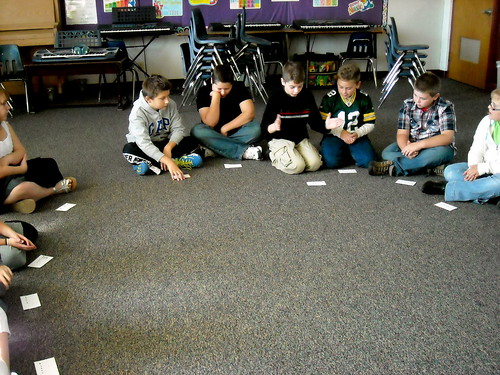
Rhythm Concentration
Everyone in the class sits in a circle on the floor.
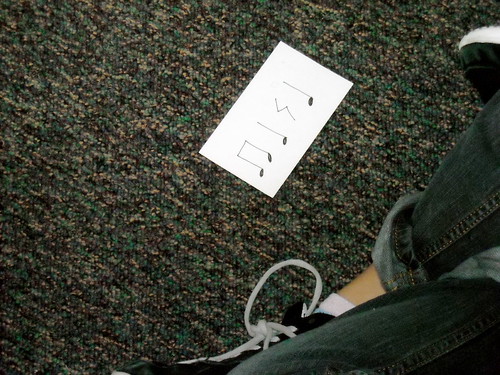
Rhythm Concentration
Each student is given a basic rhythm that was written on an index card. (I used only quarter notes, quarter rests, and eighth notes, however you could add in other rhythms your students know)

I then put a piece of tape or something to mark the 'beginning/end' of the circle. The person on the right of the marker is #1. The goal of the game is to be #1 at the end of the game.

The #1 person claps their rhythm and then #2 claps their rhythm immediately after. This continues all the way around the circle. During the first round, I normally just let them practice their rhythm. However, after that it gets harder.

Students continue clapping their rhythms as they continue around the circle. When someone misses their turn or hesitates that student has to go to the end (to the left of the marker). Their rhythm stays where it is and then students fill in the spaces. For example: if #5 of #10 misses their turn #10 shifts to #9; #9 shifts to #8; #8 shifts to #7; #7 shifts to #6; #6 shifts to #5; and #5 shifts to #10!

For those visual learners like myself, a model of the switch!:
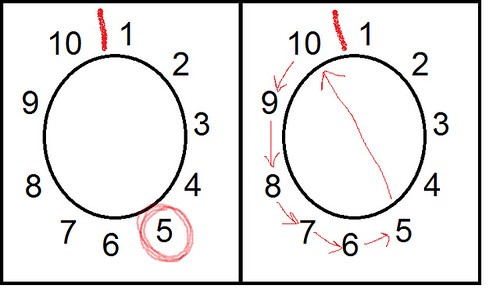
rhythm concentration switch

After that it gets even more difficult. I start sending people to the end of the circle for clapping the wrong rhythm, not doing it in beat, and I have even added the metronome for some of my older students and they have to stay in beat.
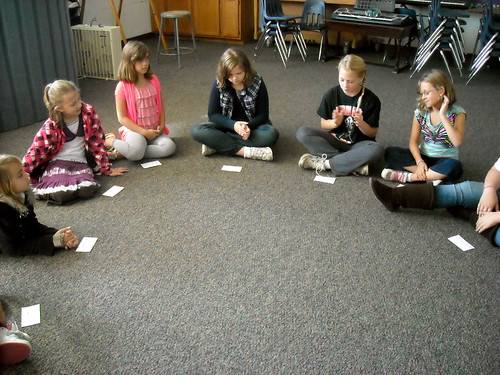
Rhythm Concentration

My students really seem to like it. What I like most about it is it is fast paced, so those that get frustrated with waiting for everyone to get a turn don't feel that way during this game. I also like it because they are practicing their rhythms without feeling like they are practicing rhythms!
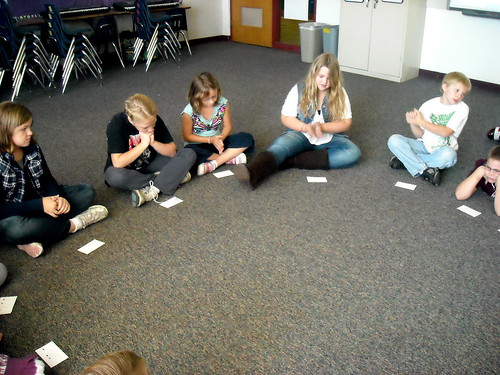
Rhythm Concentration

If you try this out, please let me know how it goes or any changes you made to make the game run smoother! Also feel free to ask me questions about it, I'll do my best to answer them. Have fun!


Tuesday, September 25, 2012

Tweet for Education

Twitter

I decided to write a blog post about tweeting, since last week we had a mini-in-service about the significance of tweeting as a professional practice. Now I know what some of you are thinking: How can you use Twitter as a professional practice? How will it better your work? What should you tweet about? What does it mean to follow someone or be followed? These are all questions I will try to answer in this post.

I myself am of the 'younger' generation. I'm what some refer to as a millennial or generation Y. The millennial generation are typically people born anywhere from the late 1970's through 2000. Millennial kids are generally marked by an increased use and familiarity with communications, media, and digital technologies. This means I have no qualms with using new technology and am constantly finding ways to use new technology in my music room. (I already have a smartboard at both schools and recently was given an iPad to use in one of my classrooms. I'm sure you will see more about this technology later in the year as I find ways to use it.)

Though I am excited about using technology in my classroom, I will admit I was a bit skeptical of twitter at first. How can you really learn anything just from 140 characters or less? However, I have found that many do not just post random things like "Today my job was super great!", but instead, they post things like "Today I played an awesome #music game with my students! Check it out (URL here)! #musiced #musedchat" They then link their post to a blog they wrote or read somewhere. These types of tweets can be really helpful.

How do you find relevant posts? By using the search bar. You can put in words or hashtags into the search bar. Hashtags are made up tags that connect people that are talking about the same thing. Some important hashtags to know, if you are a music teacher: #musiced, #musedchat, #music, and #musedmot. By searching for these hashtags you will see ALL of the posts related to that topic. You can then read different posts people made and eventually decide to follow them. To follow someone just use the simple steps highlighted below:

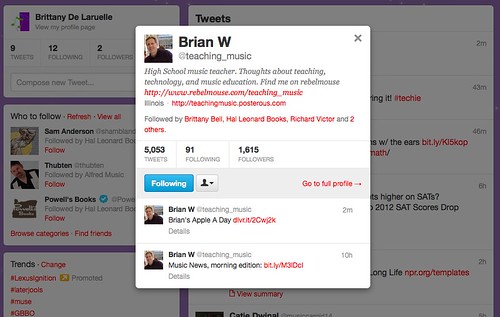
1) Find someone interesting and click on the post:
Step1

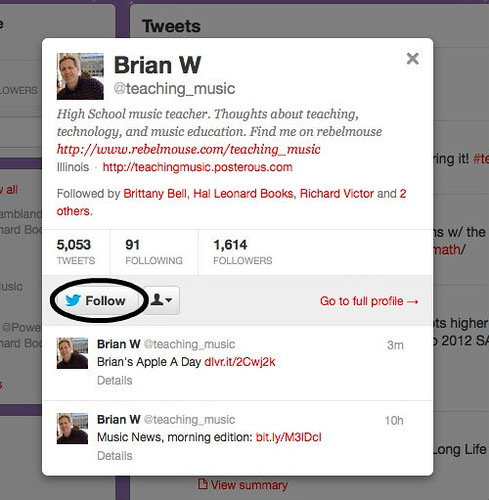
2) That will open this mini-menu:
step2

3) Click the FOLLOW button:
step3

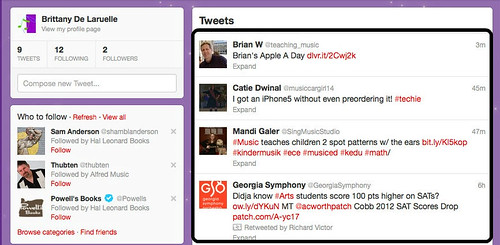
As you follow more people you will get more tweets here in your tweet feed:
step4

If you are being followed they are getting your posts!

Now, you are making links with interesting people and hearing what they find to be interesting through retweets.

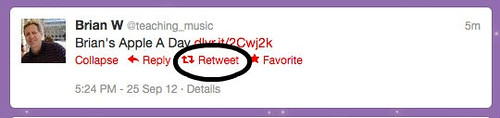
What is a retweet? Well, when you find something super interesting (which believe me you will!) just click the retweet button as shown below:
retweet1

After you retweet it, all YOUR followers will see it, too! You will also see things that your followers retweeted, which eventually can connect you to more professional music teachers! (Isn't social networking fun?)

After spending just ONE week on Twitter, I have read MANY articles about music advocacy. I have found tips for parents to use music at home. I have found ways to network with other teachers. I have found teaching tips. All of that in just ONE week. (And I only am following 12 people and followed by 2). Start small and just keep building. The more people you start following the more people that will start following you.

What should you tweet about? Anything you want to share! Wrote a recent blog post? Tweet about it! Did something awesome in your classroom? Tweet about it! Looking for helpful tips? Tweet about it! Just make sure you add hashtags so other people can find your posts! It is also okay to not tweet anything and just follow people. However, I am guessing once you start tweeting you won't be able to stop.

One more thing, while following tweets this last week. I stumbled upon something AWESOME! Apparently, there is a music education motivation day planned for September 29th. I don't know a whole lot about it, but you can learn more here. You can also look up #musedmot on twitter to find it!

Have you used twitter as a professional tool? If so, who do you follow and what have you learned or found? Have you ever considered using twitter as a way to grow professionally? Feel free to follow me @bndelaruelle and I may follow you back.

Thursday, September 13, 2012

Those Great UNPLANNED Teaching Moments...

It is hard to believe that I am already almost finished with my second week of teaching this school year. Last week was the typical 'getting started' lessons. Lots of discussions about expectations and some introductions. However, this is the first year I already know most of my students. It is so nice to be able to call most students by their names. It definitely helps with classroom management when you already have an idea of what to expect from certain students.

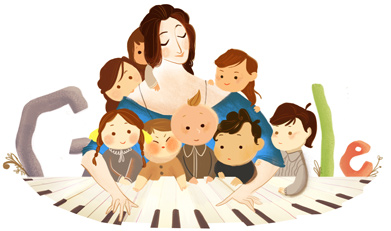
Today, the art teacher at one of my schools told me to check out the google icon today. It was an icon to celebrate Clara Schumann's 193rd birthday! Here is a picture of it for those that may have missed it:


I took this as an opportunity to share a few details about Clara Schumann with my class. It seemed to peak quite a bit of interest and I reminded them that if they went home and clicked on the picture it brings up all sorts of information about Clara.

I love finding those unexpected and unplanned teaching opportunities. It may take sometime away from the originally planned lesson plan, but you have to cease the moment sometimes. :)

Have a fabulous day! Go ahead and check out Clara Schumann on google, you know you want to!

Tuesday, September 11, 2012

Decorating Fairview

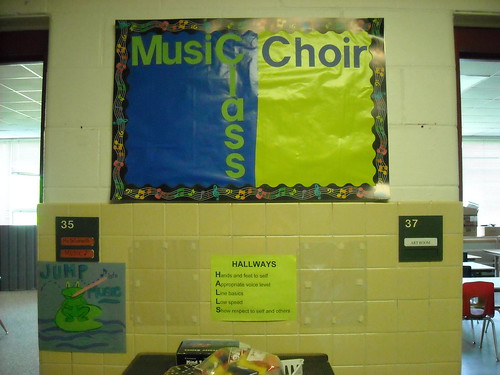
Information Bulletin Board

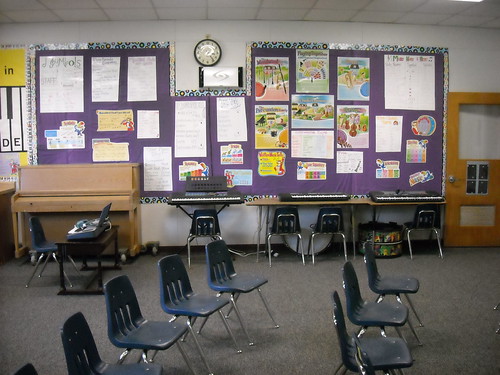
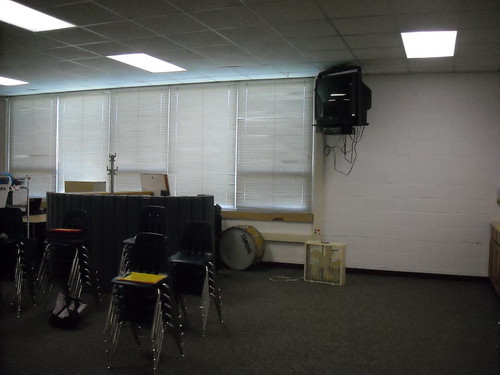
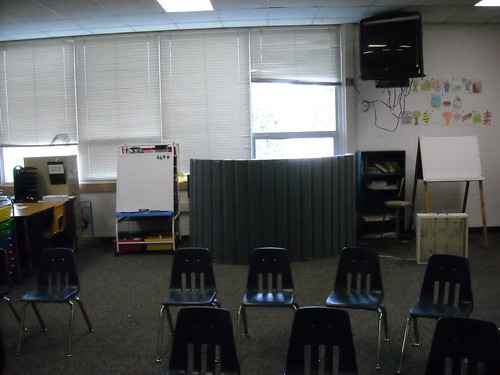
After decorating Bonduel for two days, I spent FOUR days decorating Fairview. That is the most time I have ever spent decorating my room, but it was definitely worth it!

The first things I worked on was my word wall on the south wall. This wall has a whole bunch of music words organized in categories. I know a lot of word walls are alphabetical, but I like having words in categories to make it easier for students to find the word they are looking for. I posted both posters that I bought, as well as, posters that I created this summer:

BEFORE
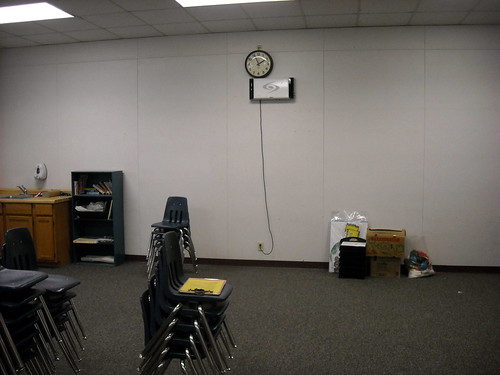
Pictures Before Decorating

FINISHED PRODUCT
South Wall (Word Wall)

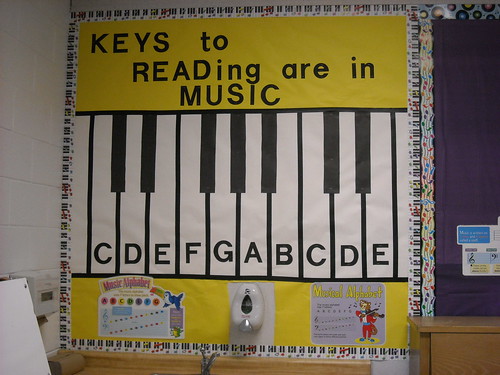
I also added an awesome bulletin board next to the word wall. This bulletin board was actually quite simple to make and I used black 'painters tape' to create the keys. It looks so great now that it is finished and it really adds something to my 'music story corner.'

Bulletin Board

The next thing I worked on was creating a small story corner. This is the corner I use when I sing a story to my little ones. That is one of my favorite things to do when teaching the little ones. I have all sorts of song storybooks and they love listening to the stories and singing along to their favorites like Puff the Magic Dragon and Over the Rainbow.

BEFORE
Pictures Before Decorating

AFTER
Reading Corner
This is not a particularly good picture... but you get the idea.

The next step was adding the learning target dry erase boards and the music alphabet like I had in Bonduel:
Day 3 Progress

The final step, creating a Student of the Month bulletin board to show the great achievements my students:
North Wall

For more pictures check out my album on my Flickr Account.
Thanks for Reading!!!