Image Map
Showing posts with label grade 4. Show all posts

Wednesday, September 10, 2014

What's Happening Wednesday

I've decided to make a pact with myself and all of you that I will blog AT LEAST once a week. To make that happen, I'm devoting part of my Wednesday routine to writing a blog post.

This week is week 2 for me. (We normally start a little later here in Wisconsin.)

Here is a quick glimpse into my week:
Kindergarten
I'm still going through the music rules step by step in my classroom. I only see Kindergarten once a week at one of my schools and since I'm introducing one Rule Song a week, they won't be done with all the rules until October. It is a little sad to me that I don't get to see them all more often, but it is what it is! At my other school we are on to rule #3 and will be finishing rule #4 at the end of this week. (That is one stress of working in two different districts, it is sometimes very difficult to keep everyone on track or to remember where I am with different classes)

For my rules this year I'm using Lindsay Jervis's Rule Songs, as they came with her Owl Themed Rules. You can find them by clicking on the picture below:

Kindergarten is also beginning to work on keeping a steady beat and using their singing, whispering, and talking voices. I have not labeled any of these things yet, since it is only the second week of school, but we are starting to explore these concepts. For each song we sing students keep a beat in various ways and I often let students pick different ways of keeping the beat. We keep the beat slowly and quickly.
Songs we are singing in Kindergarten this week:

1st Grade
Now that we are in the second week of school we are reviewing some of the concepts we learned in Kindergarten to prepare for learning ta & ti-ti. I'm not yet labeling ta & ti-ti, but we are singing various songs that we will eventually learn ta & ti-ti with.

Songs we are singing in 1st Grade this week:

2nd Grade
In 2nd grade we are going to be reviewing ta & ti-ti and are currently preparing for ta-a. In order to do this I have picked out some songs that use ta, ti-ti, and ta-a. We will learn these songs and become comfortable singing them through a couple days of practice. When students are able to sing the songs on their own we will then begin to look at finding ta & ti-ti in the songs. Then later, we will work on figuring out our new note. My goal is to have introduced ta-a (and possibly ta-a-a-a) by November when we start working on our Christmas concert.

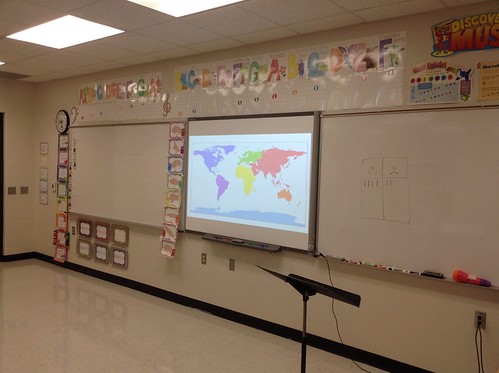
Since we are singing 2 French songs, I created a story to go along with introducing these songs by saying we were all going on a trip to France. Students had to find where France is on a map and we discussed how we would get there (plane, car, boat, etc.) This was a lot of fun. It is always great to incorporate a little bit of Social Studies into music class, as well as some global awareness.

Songs we are singing in 2nd Grade this week:

3rd Grade
Map
temp

As you can see my 3rd graders are doing similar things in music as my 2nd graders. We also looked at the map and found France. However, the reason I'm doing these songs in 3rd grade is to reinforce ta-a and ta-a-a-a. Some of my 3rd graders got to the assessment portion of half note, whole note, half rest, and whole rest, but another section didn't get to it. This will help review this concept for the classes that did assess it and prepare my other 3rd graders for assessing it.

Songs we are singing in 3rd Grade this week:

4th Grade & 5th Grade
My 4th & 5th graders ended the year after learning about ti ta ti and just beginning to look for low so and low la. I decided we would start with a couple ti ta ti songs that actually use low so and low la for added practice, since we weren't quite ready for the assessment at the end of 3rd grade. Shake the Papaya Down and Alabama Gal were two songs they learned last year that we are now reviewing ti ta ti with. When we seem comfortable with singing these songs and with the rhythm I'll start to work on the solfege for these concepts.

Along with singing my students began to learn the dance for Alabama Gal as a fun incentive for good behavior in music class. Both my 4th and 5th graders absolutely loved doing the dance yesterday, so it will be a great way to make sure we stay on task.

*NOTE: My 4th and 5th graders are around the same level because of when I started at these two schools. These classes aren't quite at the level where I would like them to be, but we are definitely getting closer every year.

Songs we are singing in 4th Grade & 5th Grade this week:

Monday, April 7, 2014

Category Rhythm Project

I'm currently working with a group of my 4th and 5th graders on a fun mini-project. We just got done learning about ti-ti-ri and ti-ri-ti, but it can be difficult to tell the difference between these two. We focused on a lot on which note gets a little bit more time. We practiced singing songs and figuring out if it gets a ti-ti-ri or a ti-ri-ti.

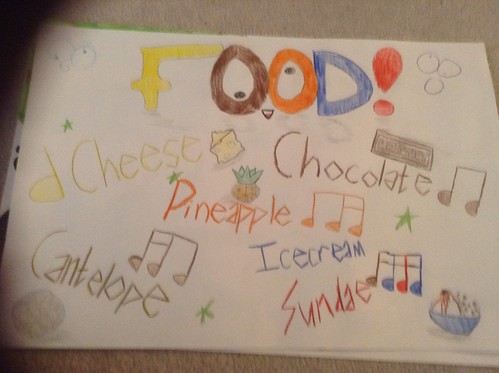
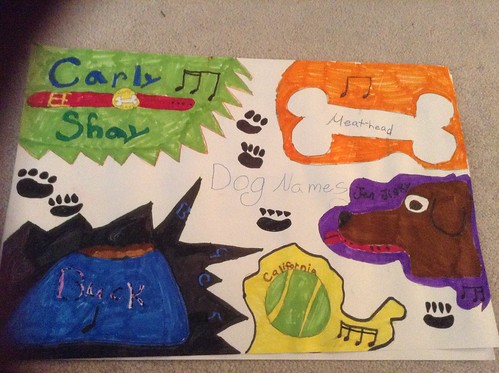
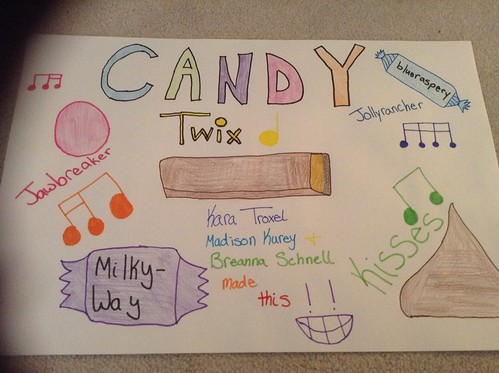
Now for some added practice I had the students split into small groups (no more than 4 people to a group and students can work on their own if they choose to). As a group they had to come up with some sort of category. It could be anything from sports to candy to states. However, once they picked their category they had to come up with words to go with each rhythm they know (1 for ta, 1 for ti-ti, 1 for ti-ti-ri, 1 for ti-ri-ti, 1 for ti-ri-ti-ri). Each word had to do with their category. I was really impressed with some of the categories students chose:
  • mythology
  • states
  • books
  • sports
  • junk food
  • fruit

The second day, students created nice posters to go with their category and rhythms. Students were expected to write the rhythm, write the word that goes with the rhythm, and draw something to go with each word on their chart.

Here are some of the finished products:
2014-04-04 17.40.50
2014-04-04 17.40.57
2014-04-04 17.41.09

I'm really proud of their hard work. I'm looking forward to displaying these at our Spring Fine Arts night at the end of April!

Wednesday, November 13, 2013

Activities Like... Note Reading Stations

I'm linking up with Blog Hoppin' today for their We're Thankful For Linky Party. Each day they are writing about something they are thankful for as teachers. Wednesday's theme is Activities Like...

If you would like to join the fun click the link below to find their post and/or read other posts written by other teachers. I especially recommend reading Mrs. Miracle's blog posts. She has been linking with them all week!


The last couple weeks I have begun the preparation of my 4th graders for playing recorders. They already had some experience reading notes on the treble clef thanks to Freddie the Frog, Music K-8 Kids Videos, and a basic introduction in 3rd grade. However, I really wanted students to get a lot of experience with note reading before I actually put the recorders in their hands. To aid in this process, I created stations around the room for note reading (and a few for rhythm work, since that is also important for recorders).

Here are the stations with information on where to get these materials online:

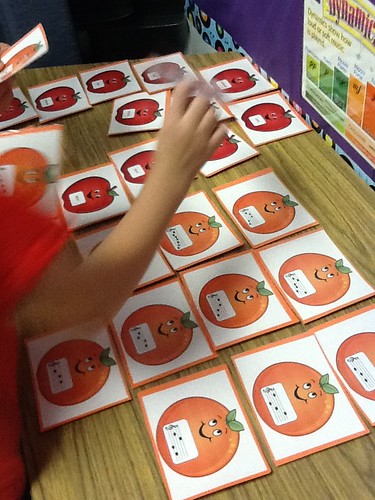
1) Apples and Oranges - Word Matching Game

appleorange

This is a pretty simple matching game that I bought from Teachers Pay Teachers. How it works is a small group of students sort the apples and oranges by trying to match the words on the apples with the words on the oranges. For example the apple will have the word FACE written on it and they have to find the orange card that spells face on the staff.

I have been a little creative with this station and have also come up with some other ways to use these cards. I have the students play a game of memory with them. (This is a bit more challenging, but is great for my high achieving groups.) I also have them race against each other to see who can get the most matches. You can get this original game HERE as part of a bundle. The bundle includes Sandwich Match, which I'm going to talk about next, and it also includes some other activities I use with other concepts.


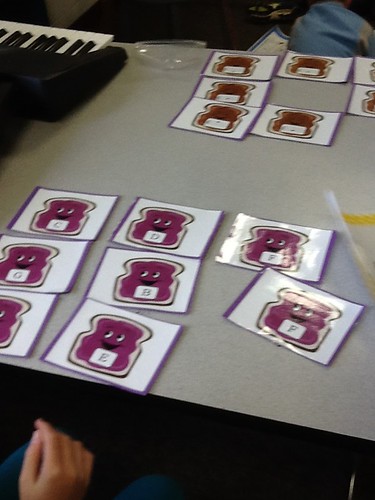
2) Sandwich Match - Letter Matching Game

peanutjelly

This game is just like the Apples and Oranges game, but instead of whole words you just match a letter. This one is a bit easier to play as memory and many of my students prefer to work at this station that way. Again you can get this HERE.


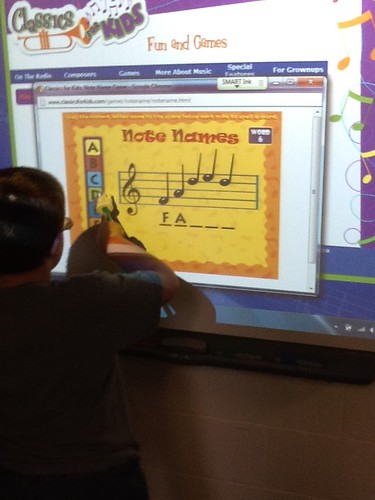
3) Classics for Kids - Treble Clef Note Reading Game

notenamegame

I allow students to play this on my Smartboard by taking turns identifying the note and creating the words. You can find this game HERE.


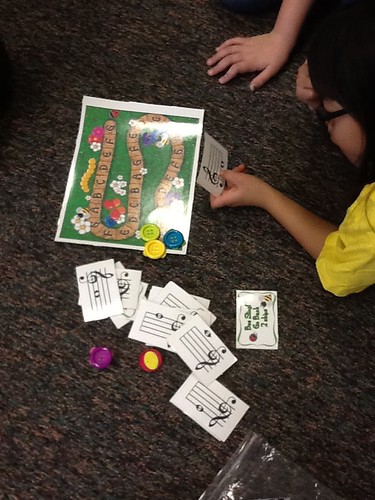
4) Ladybug Game

ladybuggame

You can find this fun game HERE. Susan has a lot of great games and you should check them out while you are there. All you need to do is print out the pdf she created and create playing pieces. For my playing pieces I used big buttons from Walmart with cute bug stickers on them. More specific directions are on the site, but the basic idea is students pick cards from the deck one at a time and move to the closest space of the letter they choose. Whoever makes it to the end first, wins. Students should take turns and if students draw a card that says bee sting or other things like that they should follow the directions on it.


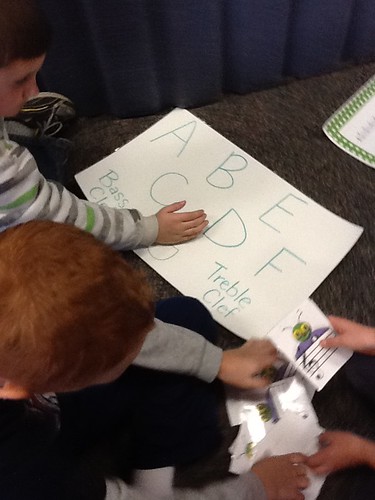
5) Fly Swatter Game

flyswatter

This is another game made by Susan. I have seen games like this, but how this works is you print out the cards onto cardstock. Then, one student holds up a card while the others find the correct note as quickly as possible and swat the correct answer on the poster board. (You could also write your answers on the board.) Whoever gets the note correct first gets to take over the cards and the other two students become swatters. You can find this game HERE.


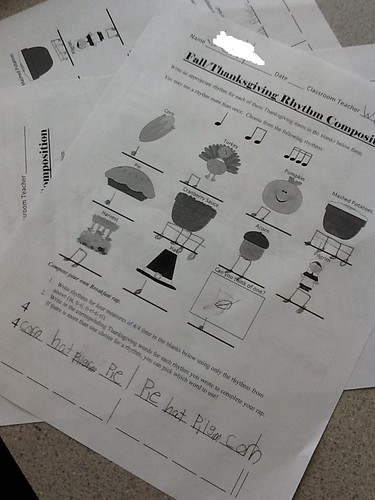
6) Fall/Thanksgiving Rhythm Composition

fallworksheet

For some rhythm work I had students working on a Fall/Thanksgiving Rhythm Composition. The top of the worksheet students figure out which note each word should get based on the amount of syllables each word has. For example they put a quarter note with corn and four sixteenth notes with cranberry sauce. After finishing the top part they can create their own Fall/Thanksgiving Rhythm and create their own rap. They fill in each blank with a word from above and add the corresponding rhythms with it. It is a fun way for students to practice their rhythms and use their own creativity. You can get this activity at my Teachers Pay Teachers store HERE.


Sunday, October 20, 2013

Sing a familiar song...with Halloween Rhythms?

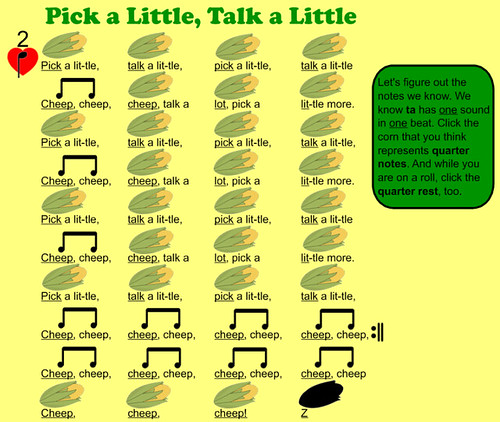
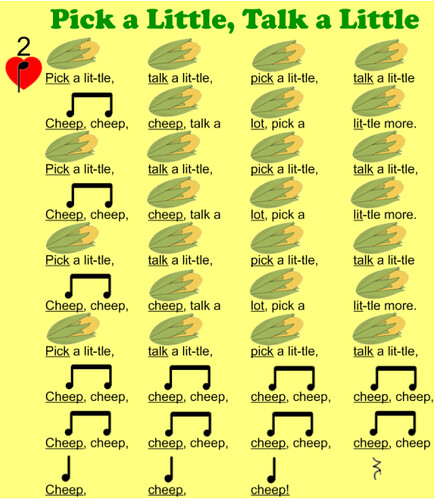
My 3rd Graders recently learned about 4 sixteenth notes (ti-ri-ti-ri) with a variety of songs we knew and learned this last month. (Our Gallant Ship, Coffee Grows on White Oak Trees, Pick a Little Talk a Little, and The Swapping Song)

We started off the month by figuring out the rhythms we already knew, like the quarter note and eighth notes:
blogpic1
blogpic2
blogpic3

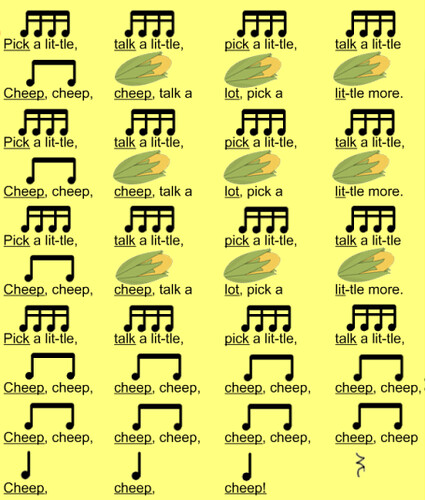
Then, as we became comfortable with the rhythms we already knew, we added in the four sixteenth note pattern - ti-ri-ti-ri (which I know a lot of you call ti-ka-ti-ka, but where I teach we are trying to be unified in our syllables and the other teachers call is ti-ri-ti-ri, hence so do I). We discussed how the rhythm has four sounds in one beat and students got a lot of practice finding the beats that represented sixteenth notes.
blogpic4

After finding the sixteenth notes we would sing the song while clapping the rhythms we knew. (We rested during the rhythms we didn't know) Then we would say the rhythm syllables instead of the words.

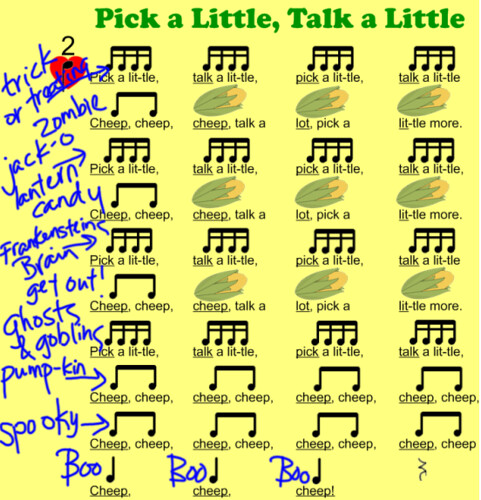
After a couple of days of finding the ti-ri-ti-ri patterns and singing and clapping them, I decided it was time for a fun challenge. First, we took one of our songs we have been singing that uses ti-ri-ti-ri. (You could pick any song, but we picked Pick a Little, Talk a Little.) Then, instead of singing the words or rhythm syllables we came up with Halloween related words to fill in the notes with. For example one line of ti-ri-ti-ri's was Trick or Treating, one line of ti-ti's was candy, and one line of ta's was boo! Each line got a new word or words to fill in the notes we knew. Then we sang the song with the new Halloween theme. It was a lot of fun and the kids were laughing and having a great time by the time we were through.

Here is an example of what it looked like:
HalloweenPick


For those that have a hard time seeing it, it says:
Trick-or-Treating, Trick-or-Treating, Trick-or-Treating, Trick-or-Treating,
Zombie! (rest) (rest) (rest)
Jack-o-lantern, Jack-o-lantern, Jack-o-lantern, Jack-o-lantern,
Candy! (rest) (rest) (rest)
Frankenstein's brain, Frankenstein's brain, Frankenstein's brain, Frankenstein's brain,
Get OUT! (rest) (rest) (rest)
Ghosts and goblins, ghosts and goblins, ghosts and goblins, ghosts and goblins,
Pumpkin, pumpkin, pumpkin, pumpkin,
Spooky, spooky, spooky, spooky,
Boo! Boo! Boo! (rest)


Tuesday, October 1, 2013

2/4 Tuesday - Rhythm Practice


For this weeks 2/4 Tuesday I thought I would focus on rhythm practice. This time of year I review the rhythms students already know, plus I start introducing new rhythms. To go along with this I love to have games, activities, and apps to reinforce these concepts. Last year, I shared a game that I created for this purpose called Rhythm Concentration. You can learn more about that game HERE. However, here are a few more resources I have found.

Rhythm Football
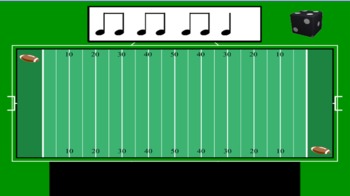
This is a fun interactive SMARTboard file that you can get for FREE at TeachersPayTeachers. I found this game last year and my students love it. I have found that any rhythm activity that includes a sport in it is a great way to get boys excited to practice their rhythms. Unfortunately, if you do not have a SMARTboard you will not be able to have access to this file.

Poison Rhythm
poisonrhythm
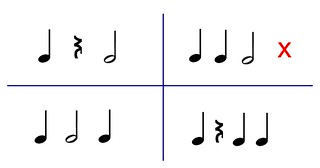
This is a simple game and quite easy to adapt to any grade and any rhythms you want to work with. You start by writing four rhythms on the board, as depicted in the picture above. Then I mark one with an 'X' (somtimes I allow the students to pick the poison rhythm instead). The 'x' represents the poison rhythm. I clap one of the four rhythms and students should echo me by clapping the rhythm back. If I clap the poison rhythm they do NOT clap. The game is set up as teacher vs. student, so when I clap the poison rhythm either the students get a point (for not clapping) or I get a point (because they clapped the rhythm - even if it is just one student!). Sometimes I have classes that do not participate or just stop clapping all of the rhythms. When this happens I tell them I get points for them NOT clapping non-poison rhythms as well. This normally solves that problem.

Rhythm Cat
Rhythm Cat is an Ipad App for practicing rhythms. It is actually kind of fun even for a teacher. How it works: Students look at the rhythm and push the green button as they play the rhythm. When they play the rhythms correctly the notes light up green and they get to move on to the next level. If they don't hold the button down at the right time or long enough, etc. the notes turn red and if they miss a lot of notes they do not get to continue on to the next level. (click the picture to find more information about it)

Monkey Drum
Monkey Drum is another Ipad App for rhythm practice. This can be just a cute app for students to create and play with, but how I use it in my classroom is for rhythm practice. At the end of a class I'll pick students to play rhythms on the monkey drum app. After they play the rhythm the monkey will play the rhythm back. This is a great way for me to assess if students can play the rhythms correctly and to assess if other students can HEAR mistakes in a rhythm. It is a very cute free app, so there is no reason not to at least check it out. (click the picture to find more information about it)

Monday, September 23, 2013

Manipulative Monday - Music Time Signature Pies


Yay! Not only two blog posts in a row, but I'm also joining my first Link Party! Music teachers are so cool! :)

Honestly, I wish I used more manipulatives in my classroom. I'm hoping reading all these posts will inspire me to actually go for it and do it. I also have to do a better job of looking out for some of those cool finds like the erasers I saw in Lindsay's blog.

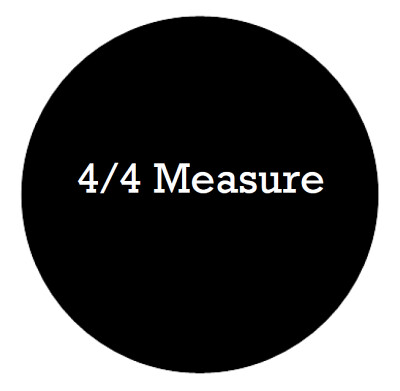
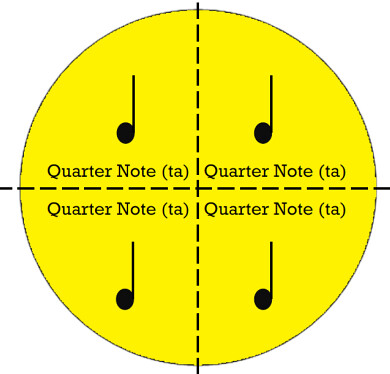
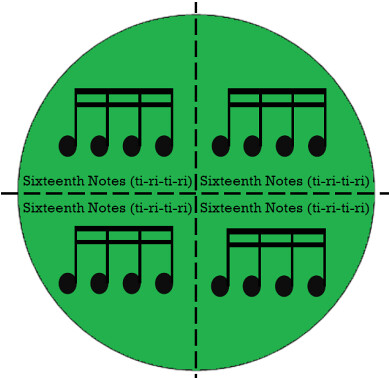
Instead, one manipulative I have used for time signatures are these music pies I created. Each pie represents a measure in 4/4 time. The black one is the filler for students to create their own measures:
meter

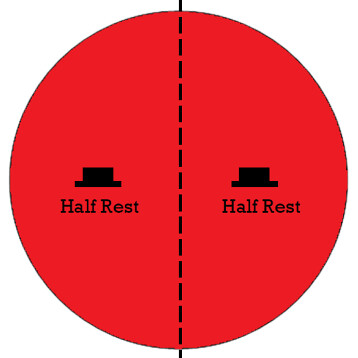
Then, I have several colored pies for the different notes my students know. I cut each one along the dotted lines so that the pieces only fill up the amount of the measure they take up. Here are a few examples of my music note/rest pies:
halfrest

quarternote

sixteenthnotes

This allows my students to create their own measures and see how they fit into the measure. This is great for kids that really need a visual or are more kinesthetic in nature. When working on a short composition students can check their work by putting the pieces together. If there are too many beats they know they have to fix something. If they have extra space in their measure they know they need to add another note.

For those that are interested they were added to my Teachers Pay Teachers Store and are completely FREE! Just print them, cut them, laminate them and you are ready to go! Please let me know if you use them and how they worked for you.

signature

Sunday, April 7, 2013

Music Jeopardy

My students LOVE music Jeopardy games. All my 3rd, 4th, and 5th grade classes ask for it and I make sure they get to play it at least once each year. It is a great way to either review information or assess students knowledge of the material. The great thing is if you create your Jeopardy game using smart notebook you can even add in short listening clips to assess students ability to hear different instruments, genres of music, etc. I created my first Jeopardy game on the smart board last year and then adapted it a bit this year. I have a Jeopardy game for Instrument Families (3rd grade), Instrument Families and their TIMBRE (4th grade), and Ensembles (5th grade).

These are the rules (I have them typed up on the smartboard file):
  1. Students will be chosen by random drawing of popsicle sticks. When your number is called you will get a choice between the categories and numbers left on the board. Once your number is drawn it will not be picked again until all other numbers on your team are drawn.

  2. Once a category and question is selected student will be given 1 minute and 30 seconds to answer. If no answer is given question is turned over to other team. (Some questions have a multiple choice option. Depicted by the multiple choice icon.)
    If a student has difficulty they can click the multiple choice option ONLY IF BEFORE time is up. – Once multiple choice options are given student only gets 45 seconds to choose an option regardless of how much time was left on the clock before and they receive half the points. (If question gets overturned the opposite team also only gets half the points as they already saw the choices.)

    ---I also say that if the multiple choice option was not selected by the original team and it goes to the opposing team for a steal the opposing team can NOT choose the multiple choice. They must answer the question without the choices.---

  3. If question is overturned due to wrong answer or running out of time a number from the opposite team will be drawn at random to steal the question.

  4. After each question regardless of right or wrong answer the opposite team will get a turn. Going back and forth ALL through the game. (The only time the same team gets 'two turns in a row' is if they steal and then it is their turn or if they get a Daily Double)

  5. Two DAILY DOUBLES are hidden in the game. If you pick one of these your entire team will get to decide how many points you are betting. There will be no multiple choice given, but the whole team will get 2 minutes to come up with an answer. If the answer is incorrect or no answer is given after 2 minutes betted points will be deducted and game will go back to regular play. Student who picked DAILY DOUBLE will get a turn to pick next category to answer on their own.

  6. Students must be quiet during the game to allow students answer questions to think. If talking name will be put on the board and if they receive one check they will have to take test version of the game, as well as, get a popsicle stick (this is part of my own behavioral system).

  7. All teammates should be positive and show good sportsmanship. If there is name calling, bragging, etc. points will be deducted from that teams total.


If you are using this to assess students knowledge or even as a review, I normally keep track of students points and what questions they pick. That way I am able to go back and see if a certain category gave students problems, if a student only picked 'easy' questions, etc.

The best part about Jeopardy is that even if a team is down by a lot of points they may still win in the end with a Final Jeopardy question.

Now I know there are many different Jeopardy games templates already out there, but if you want to see the Jeopardy games I created to get an idea of how they work or you can adapt if for you classroom, feel free to leave a comment with your contact information and I can send you the file you are interested in seeing.

Wednesday, October 31, 2012

Describing Music using Music Terminology

One of the things I'm really working on with my older students (3-5 grade) is describing music using musical terms. I explained to one of my principals that I feel this is an important skill that can really help students appreciate music in a whole new way. How cool is it when a student can pick out instruments in a pop song or describe differences in tempo. This is a skill that all kids can learn and use even if they never continue on in music.

I first emphasized this skill during our outdoor music classes (read more...).

When we went outside I had my students sing I Love the Mountains. Later, I had my students write a short reflection on the difference of sound singing outside verses inside. They were encouraged to use music words from the word wall.

Most of the reflections said things like:
  • The sound echos more inside than outside
  • We sang quieter outside rather than inside
  • There were other noises outside like leaves rustling and birds chirping
  • Our sound was much more blurred together outside

After this reflection I realized I really needed to show students HOW to use music terminology in their reflections without having to change what they are saying. In order to do this I came up with a reflection assignment students had to do for homework. (I rarely give homework, but this was a simple assignment and they were given 2 weeks to complete it)

First, I showed students some examples of reflections they wrote:
I Love the Mountains sounded different outside because it echoed less outside than inside. I also thought we sang a lot quieter outside. I also noticed that outside the music was much more blurred together where as inside it was much more disconnected.
Then, I showed them how they could just substitute a few words for music words and it still was saying the same thing.
I Love the Mountains sounded different outside because it echoed less outside than inside. I also thought we sang at a piano dynamic outside. I also noticed that outside the music was more slurred or legato rather than inside where it was much more staccato.
Finally, I gave them the assignment (this was partially an idea I was given by my school principal to also include some technology):
Students should write a short music reflection about a song that they have listened to during the month. This allows students the opportunity to listen to any song they enjoy and still be practicing writing and using music terminology. *NOTE:I even allowed non-school appropriate songs as long as they had permission from their parents. That way they could truly listen to whatever kind of music they like*

All responses were emailed to me unless they could not because of not having internet or computer access at home. I also printed out a few paper copies for these students, but they were responsible for picking them up from me.

I posted all information on my school website so students could access it at anytime. Along with this I posted: the questions they were to answer, links to music videos they may like to watch for the assignment, a word bank of musical terms to use in their reflection.

This assignment was due by Halloween and I do have to say it was such a fun experiment. I did have quite a few students that I was constantly hounding to turn in their assignment (what is new), but the responses were great! I also had quite a few students that were really excited about the assignment and enjoyed the videos I posted. It was also a great way to include technology and writing into my curriculum. (Two school goals for Fairview Elementary.)

You can see all the directions for the assignment, video links, and word bank all on my school website -->here<--. Feel free to steal the idea and even the word bank, just let me know how it works for you. :)

Happy Halloween! BOO!

Tuesday, October 16, 2012

Outdoor Music Class!

Sound Effects
Last week I decided to take all of my Fairview students outside for music classes. I decided to do this after having a short chat with a 2nd grader who often acts up in my class. He had kind of a rough day about two weeks ago and broke down in tears after music class. I asked him if he was crying because he got in trouble, to which he replied "No! I just really miss my mom!"

Fairview has an outdoor classroom that they refer to as The School Forest. At first, I wasn't sure what we should do outside. It would be easy to just go out there and sing different songs we sing in music class. However, I feel that when you are going to a new environment you should take advantage of it to the best of your abilities.

After much thought I came up with lesson plans for each class. I will introduce the ideas here with a brief description, but I'll also post more details on each project in later blog posts. This way you can get the materials I used for the lessons, as well as, see some pictures. (I don't want to bombard you with a whole week of lessons in one post!)

All my classes had to walk on the forest path in silence. While they did this they were to listen to the sounds of fall. When we reached the outdoor classroom, I then had students share what they heard. We talked about what music was and how the music of fall would be different than the music of winter. They imagined some of the sounds they may hear in the winter rather than the fall. I especially found this activity cute when one of my kindergarteners on the second day of going to the forest told the class that he heard some beautiful music on his walk to the school forest. This was without even being told to listen for music! :)

Sound Effects

In Kindergarten and 1st grade students had to find an item in nature that could be used to create music. They then shared these instruments with the class and showed them how to play their instrument. (Read more about outdoor instruments...)

2nd grade was working on a sound effects project out in the school forest. (Read more about sound effect project...)

3rd grade was finishing up their ostinato patterns, so the first day they shared their patterns with the class. The second day they did something similar to what the 4th and 5th graders did. (Read More about the Ostinato Pattern Project...)

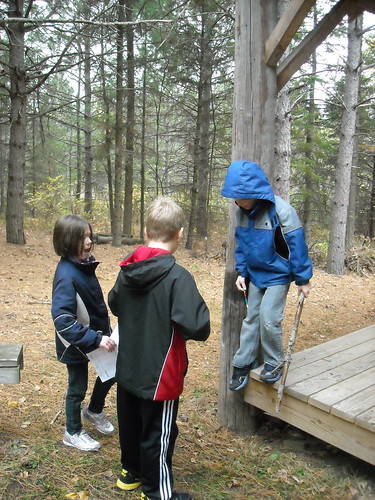
4th and 5th graders went out the school forest and sang I Love the Mountains. Afterwards they were asked to write a short reflection on this experience. They were to describe the difference in singing outside versus inside. We then talked about what makes a good reflection and ways to describe the sound of our own singing or of instruments playing, etc. 4th and 5th graders then created their own 2 beat ostinatos with a partner, as well as, a 3 beat ostinato with their partner. Students created and practiced them the first day and then shared them the second day. (Read More about reflections...)

Overall, I really enjoyed taking the kids out for music class. I was surprised by how many of my students, that don't always care for music, were really excited about music since we were going outside. I also noticed that some of my overly rambunctious students were actually really well behaved outside.

Have a musical day!

Tuesday, October 9, 2012

Go Pack Go!

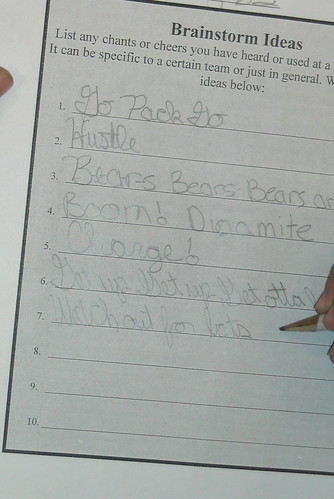
It is that time of year... Football season! Though, I myself am not a particularly devoted football fan, I spent most of my life in Green Bay, Wisconsin. This means that I probably bleed green and gold whether I would like to or not. This weekend I actually went to the Packers vs. Saints game, which made me even more excited about my latest composition project. I can't take all the credit for it, I got the original idea from a book a retired music teacher gave me. It allows students the opportunity to take chants they would hear at a football game and turn them into rhythm ostinatos! This was perfect since my grade 3-5 classes have been working on rhythms and ostinatos! :)

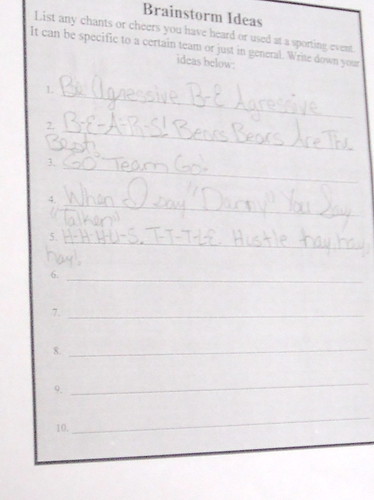
I broke this project into just two 30 minute music classes (which in my opinion is a rather quick composition project compared to some others I have done). The first day is a brainstorming day. I pair the students into groups of about 3 or 4 students. These groups then brainstorm and come up with at least 10 chants they have heard or would cheer at a sporting event. (Note: I said sporting event to reach some of my students who do not like football, but may enjoy other sports)
Ostinato Cheer Composition

The second day was devoted to writing the rhythms that go with the chants. We talked first as a class about how to figure out the rhythms. We talk about where the beat lands and how sometimes we stress different parts of a word or phrase. I give them a couple examples of my own (I chose non-sports related things so they weren't just using my examples). The groups then worked on their chants. I had the 3rd graders have 3 final cheers, 4th graders 4 cheers, and 5th graders 5 cheers. I was really impressed with some of the cheers that they created and how well they put the rhythms together. The ones that had a little bit more difficulty, or just added quarters for all of their chants, were easy to help. I just read through their chants as written and they told me if it was right or not. If it wasn't we figured out how to fix the problem together.

I found that just like with many other group activities you have those groups that get done in 10 minutes and then the other groups that work the entire 20 minutes. For this situation you should probably have some extra game or work for the groups that are done quickly. This stops students from wandering around the room or just chatting about nothing in particular.

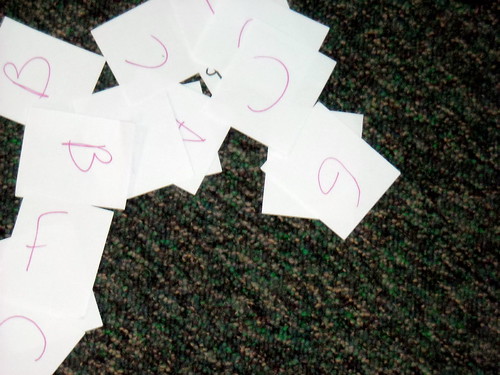
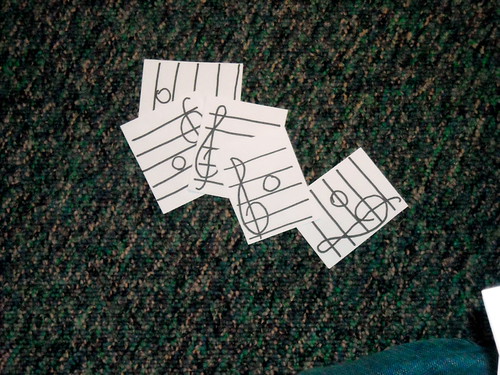
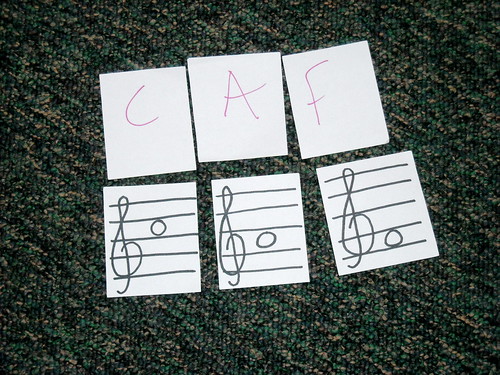
For my quick finishing groups, I created a simple game to work on for the remainder of time. Each group got a baggy with 3 sets of music letters and 3 sets of treble clef staff notes to match. One teammate would create a word using the music letters (i.e. DAD) and then the other group members would work to match up the treble clef staff notes. This way they were working on treble clef note reading without getting bored and distracting their teammates.
Note Reading
Treble Clef Notes
Writing and reading music

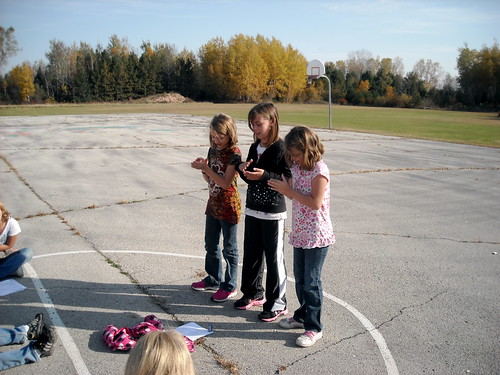
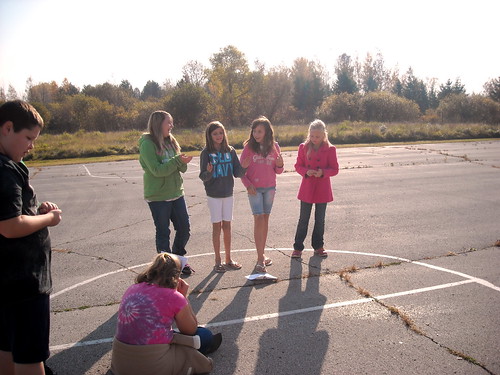
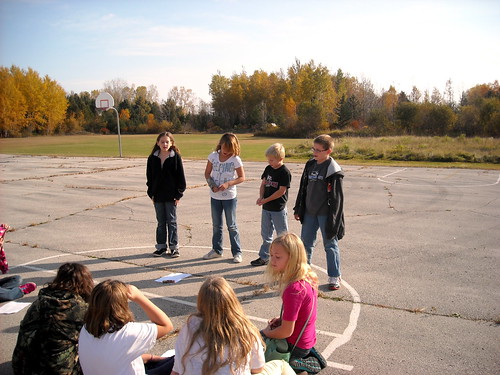
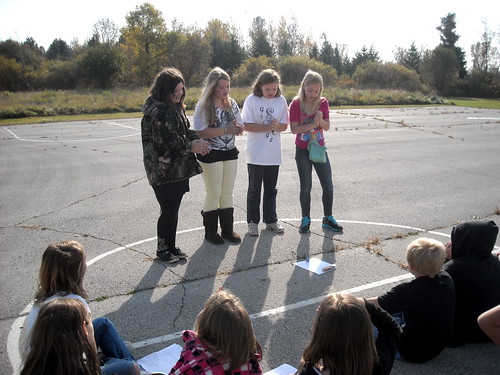
After the compositions were finished I brought students outside to share their chants with the class. I chose to go outside, not because it is particularly a loud process (though it can be) but because the snow will soon be coming here in Wisconsin and my students love being outside. That and I am really working to reach all of the multiple intelligence's in my classroom this year and one that I am particularly weak on is the nature intelligence. You will probably see more nature based lessons in the coming week as I prepare to bring my little ones outside to explore the music of the fall!
Ostinato Performance
Ostinato Chant Performance

If you are interested in this project you can get the document I created --->HERE<---

You can also use --->my rubric<--- that I created for grading the compositions.

Happy composing!