Image Map
Showing posts with label percussion. Show all posts

Thursday, March 28, 2013

Percussion Family Through Exploration

Sorry it has been such a long time since I last posted. I started writing this blog post quite a while ago, but never got around to finishing it and posting it. I have a bunch of other posts started, too. I'm hoping to post them the next few weeks.

One of my favorite activities I have done with my students for the Instrument Families unit was with my 3rd grade students. For each of the instrument families I normally use a crossword for note taking and to keep students on task. The kids normally really enjoy following along with the crossword and we fill it out as a class.

The instrument family I have the hardest time teaching about is the percussion family. The percussion family is simple and easy, so there is not a lot of things I see the need to teach them about. The past several years, I have decided the biggest thing I want students to know about the percussion family (other than the fact that they need to be hit, scraped, or shaken) is that they can be both pitched and unpitched. This is the only instrument family that has both pitched and unpitched instruments. However, for kids to actually learn this they need to know and understand the difference between pitched and unpitched instruments.

This year I had a new idea on how to teach this concept. I was trying to come up with a way that would allow the students to be more active in the learning rather than them just listening to me talk. So instead, my lesson was a stations set-up. I put out 9 different percussion instruments around the room: piano, xylophone, hand bells, triangle, tambourine, hand drum, rhythm sticks, maracas, and cymbals. Along with this I put together a rather simple worksheet that had the instruments and a line for students to write if the instrument was pitched or unpitched.
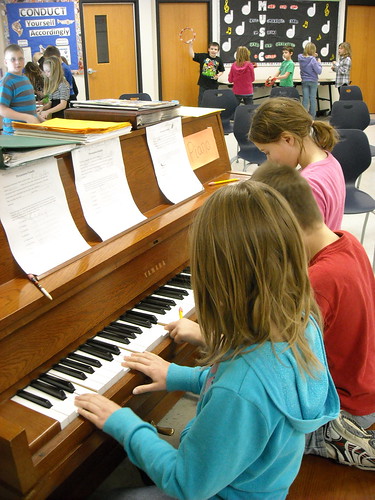
Piano Station

As a class, we talked about what a pitched instrument is and what an unpitched instrument is. We went through some examples and talked about how to tell the difference. Then, after putting kids into small groups I let them loose around the room. They each were assigned their first station and then after about 3 minutes at each station they switched to the next station.
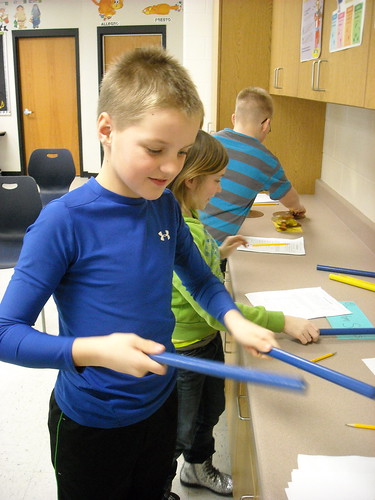
Rhythm Sticks Station

My expectations were simple:
  1. They needed to decide and write down their answer first!
  2. Play on the instrument respectfully
  3. As soon as the timer goes off everyone switches right away

Xylophone Station

As long as they followed the directions they could continue around the room. If they did not follow the directions they had to sit out for as long as I asked them and make up the work for the stations they missed during recess. (I didn't actually have to do this with any of the kids as they were all too excited to be allowed to play the instruments.)

Triangle Station

After three classes of this activity I found that about 95% of students understand the concept and did very well on the worksheet. The other 5% came in during recess and worked through the stations with me to see what they were having difficulty with.

The amount of fun the students were having and the positive results definitely mean I will be doing this activity again in the future.

Edited 1/7/15 - You can actually get this worksheet for FREE in my Teachers Pay Teachers Store. You can download it HERE

Wednesday, January 16, 2013

Have You Been to Melody Street?

One of my favorite things to teach about are the instrument families and the various instruments. I teach this unit in three sections:

3rd grade learns about the four instrument families and the instruments from the orchestra that belong to these four families. We focus on the characteristics of each family and talk about how non-orchestra instruments would also fit into the four families.

In 4th grade we add on to their knowledge about the four instrument families and we focus more on the sound of each instrument and their particular instrument family. We talk about the word timbre and we learn how to describe music using various timbre words.

Finally in 5th grade we talk about various ensembles and how different ensembles use different groupings of instruments. They have to use their knowledge of instrument families and instrument timbres to arrange instruments into various ensembles. Some of the ensembles we focus on are concert band, orchestra, jazz band, and

This year, I'm more excited to teach instrument families than I have EVER been before. This is due to some of the amazing resources I have found. There are so many great youtube videos and games I plan on using for this unit. I'll share different ones in the next few days and weeks, but I'll start with one I have been using with my 3rd graders.

Last summer, I stumbled upon this gem. It is a story called Melody Street. Some of you may have already heard of it. It is a story about the instruments of the orchestra and it plays the sounds of the instruments as the story is read to the kids. The story is in three chapters and I find it to be very interesting.


When I first found the story, I was a bit worried about using it. I was excited, but 3rd graders can be so fickle at times. I love teaching 3rd grade, but they tend to be in that stage where some things are now too 'kiddie' for them. I decided to be brave and just try it this year as an introduction into studying the instrument families. To my delight they LOVED the story and many of them stated "That was really good!"

We have been reading the story in chunks. We read the first chapter the first day and then we got through part of the 2nd chapter. The only thing that bothers me about the story if you cannot start in the middle of a chapter. I want the kids to have the full experience of hearing all the instruments playing, but I am not sure how to finish the chapter without starting all over. (The second chapter is about 15-20 minutes!)

Anyways, there is also a Melody Street site with different music games and activities. One I particularly find useful and will probably use with one of my classes is one where the students have to identify the instruments by sound.


Hope you enjoy these resources as much as I do. Do you have any other cool instrument sites to share?