Image Map
Showing posts with label instruments of orchestra. Show all posts

Wednesday, February 5, 2014

2/4 Tuesday - Worksheets, Activities, and Freebies

Time for another 2/4 Tuesday post. A linky party with Steph's Stay Tuned blog. Check it out by clicking the 2/4 Tuesday picture below.


I know it is actually Wednesday, but it has been a LONG week already. I've been home sick for the past two days. I can't complain, since the last time I was sick was almost 10 months ago, but I've never had to call in sick two days in a row. Here's to hoping I feel well enough tomorrow to go back to school.

I have two different things to share with you today:

1) Instruments of the Orchestra Worksheets
I created three crossword puzzles for teaching about the brass, strings, and woodwind families. I like to have fun when teaching about the instruments. These puzzles make taking notes more interesting for my 3rd graders and for me. Each one has different questions about the instruments in the family.

My percussion worksheet is a little bit different, as there is not as much I want students to really know about percussion instruments. What I really want students to understand about percussion instruments is the fact that they can be pitched and non-pitched. So, the worksheet I created for the percussion family is for students to play different percussion instruments and decide which ones are pitched and which ones are non-pitched. You can learn more about my percussion activity in a blog post from last year HERE.

I have used these worksheets for four years now and have continued tweaking them each year. As a special thanks for all of my readers and followers, I have added these worksheets and a SMARTboard review file to my Teachers Pay Teachers store for FREE! Just click the picture below to grab it. Please leave me feedback and if you aren't already following me, feel free to. I'm only 25 followers away from having another HUGE celebration.

IofOrch-preview

2) Textbook Scavenger Hunt
One of my goals for this year is to help my students learn the music vocabulary. I've tried many different activities, but vocabulary is just a hard thing to teach. Last week, I found an activity that reinforced some of the vocabulary my 2nd graders have learned this year.

Here is how the activity works:
  1. I started by writing a vocabulary word on the board (example: bar line).
  2. Students searched for that symbol in their book as quickly as they could.
  3. When students find it they keep their hand in the book with the book closed. I walk around and check the students that found it.
  4. After I check everyone (they only get one try), I put the symbol up on the board for everyone to see.
  5. Each word is worth a different amount of points based on its difficulty. (I just asked the students to keep track of their points, but you could also keep track if you wanted.)
  6. I kept going with different words and at the end of the game gave stickers to kids that got a certain amount of points.

I was surprised to see how excited my students got about this game and was glad I could help them practice their vocabulary.
Sunday, April 7, 2013

Music Jeopardy

My students LOVE music Jeopardy games. All my 3rd, 4th, and 5th grade classes ask for it and I make sure they get to play it at least once each year. It is a great way to either review information or assess students knowledge of the material. The great thing is if you create your Jeopardy game using smart notebook you can even add in short listening clips to assess students ability to hear different instruments, genres of music, etc. I created my first Jeopardy game on the smart board last year and then adapted it a bit this year. I have a Jeopardy game for Instrument Families (3rd grade), Instrument Families and their TIMBRE (4th grade), and Ensembles (5th grade).

These are the rules (I have them typed up on the smartboard file):
  1. Students will be chosen by random drawing of popsicle sticks. When your number is called you will get a choice between the categories and numbers left on the board. Once your number is drawn it will not be picked again until all other numbers on your team are drawn.

  2. Once a category and question is selected student will be given 1 minute and 30 seconds to answer. If no answer is given question is turned over to other team. (Some questions have a multiple choice option. Depicted by the multiple choice icon.)
    If a student has difficulty they can click the multiple choice option ONLY IF BEFORE time is up. – Once multiple choice options are given student only gets 45 seconds to choose an option regardless of how much time was left on the clock before and they receive half the points. (If question gets overturned the opposite team also only gets half the points as they already saw the choices.)

    ---I also say that if the multiple choice option was not selected by the original team and it goes to the opposing team for a steal the opposing team can NOT choose the multiple choice. They must answer the question without the choices.---

  3. If question is overturned due to wrong answer or running out of time a number from the opposite team will be drawn at random to steal the question.

  4. After each question regardless of right or wrong answer the opposite team will get a turn. Going back and forth ALL through the game. (The only time the same team gets 'two turns in a row' is if they steal and then it is their turn or if they get a Daily Double)

  5. Two DAILY DOUBLES are hidden in the game. If you pick one of these your entire team will get to decide how many points you are betting. There will be no multiple choice given, but the whole team will get 2 minutes to come up with an answer. If the answer is incorrect or no answer is given after 2 minutes betted points will be deducted and game will go back to regular play. Student who picked DAILY DOUBLE will get a turn to pick next category to answer on their own.

  6. Students must be quiet during the game to allow students answer questions to think. If talking name will be put on the board and if they receive one check they will have to take test version of the game, as well as, get a popsicle stick (this is part of my own behavioral system).

  7. All teammates should be positive and show good sportsmanship. If there is name calling, bragging, etc. points will be deducted from that teams total.


If you are using this to assess students knowledge or even as a review, I normally keep track of students points and what questions they pick. That way I am able to go back and see if a certain category gave students problems, if a student only picked 'easy' questions, etc.

The best part about Jeopardy is that even if a team is down by a lot of points they may still win in the end with a Final Jeopardy question.

Now I know there are many different Jeopardy games templates already out there, but if you want to see the Jeopardy games I created to get an idea of how they work or you can adapt if for you classroom, feel free to leave a comment with your contact information and I can send you the file you are interested in seeing.

Thursday, March 28, 2013

Percussion Family Through Exploration

Sorry it has been such a long time since I last posted. I started writing this blog post quite a while ago, but never got around to finishing it and posting it. I have a bunch of other posts started, too. I'm hoping to post them the next few weeks.

One of my favorite activities I have done with my students for the Instrument Families unit was with my 3rd grade students. For each of the instrument families I normally use a crossword for note taking and to keep students on task. The kids normally really enjoy following along with the crossword and we fill it out as a class.

The instrument family I have the hardest time teaching about is the percussion family. The percussion family is simple and easy, so there is not a lot of things I see the need to teach them about. The past several years, I have decided the biggest thing I want students to know about the percussion family (other than the fact that they need to be hit, scraped, or shaken) is that they can be both pitched and unpitched. This is the only instrument family that has both pitched and unpitched instruments. However, for kids to actually learn this they need to know and understand the difference between pitched and unpitched instruments.

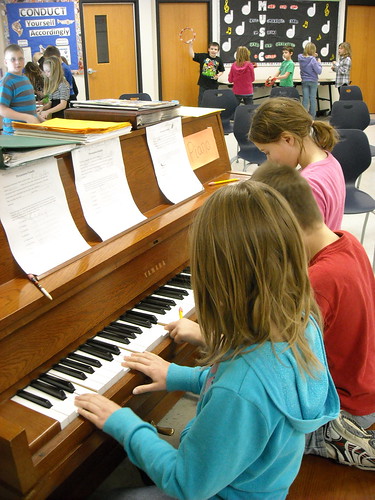
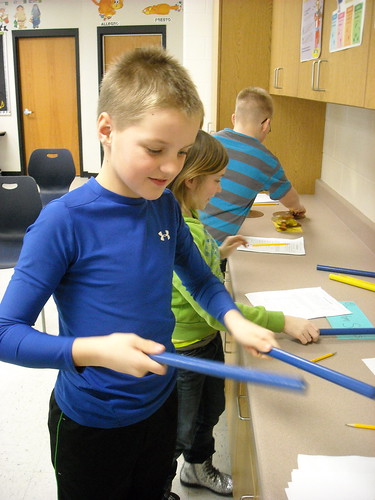
This year I had a new idea on how to teach this concept. I was trying to come up with a way that would allow the students to be more active in the learning rather than them just listening to me talk. So instead, my lesson was a stations set-up. I put out 9 different percussion instruments around the room: piano, xylophone, hand bells, triangle, tambourine, hand drum, rhythm sticks, maracas, and cymbals. Along with this I put together a rather simple worksheet that had the instruments and a line for students to write if the instrument was pitched or unpitched.

Piano Station

As a class, we talked about what a pitched instrument is and what an unpitched instrument is. We went through some examples and talked about how to tell the difference. Then, after putting kids into small groups I let them loose around the room. They each were assigned their first station and then after about 3 minutes at each station they switched to the next station.

Rhythm Sticks Station

My expectations were simple:
  1. They needed to decide and write down their answer first!
  2. Play on the instrument respectfully
  3. As soon as the timer goes off everyone switches right away

Xylophone Station

As long as they followed the directions they could continue around the room. If they did not follow the directions they had to sit out for as long as I asked them and make up the work for the stations they missed during recess. (I didn't actually have to do this with any of the kids as they were all too excited to be allowed to play the instruments.)

Triangle Station

After three classes of this activity I found that about 95% of students understand the concept and did very well on the worksheet. The other 5% came in during recess and worked through the stations with me to see what they were having difficulty with.

The amount of fun the students were having and the positive results definitely mean I will be doing this activity again in the future.

Edited 1/7/15 - You can actually get this worksheet for FREE in my Teachers Pay Teachers Store. You can download it HERE

Sunday, January 27, 2013

Safe Share Instrumental Videos

As I stated in an earlier post, I am currently working on teaching different instruments of the orchestra and various ensembles. In my experience, any time I can share a cool video with my kiddos they get SO much more excited about what we are working on. This is especially important to me because if the kids don't have fun learning about it they tend to not actually listen -or- learn. Plus, I find that some students will enjoy the work no matter what, but others need a little inspiration to make them excited about the subject.

My trick is to use videos of popular artists on YouTube or new and interesting videos that relate to the topic. On my professional website I list all sorts of links to these videos for my students to watch at home, at their convenience. I also show various videos in class when they relate. This gives me the opportunity to show or remind the students of these videos and spark their curiosity. My philosophy is to get kids excited about music and have them involved in music even outside of music class. If that means watching an orchestra play a Katy Perry song or Bruno Mars song, I feel I'm still building their music pallet. This is not something they would probably search out themselves, but they are still excited about it!

As I stated before, I have MANY videos on my school website, but I'm going to share just a few that I have used for this instrument families unit:

The Vegetable Orchestra - People creating instruments using vegetables. Great way to introduce the orchestra or just talk about non-traditional instruments.


Cello Wars by The Piano Guys - This is a piece by The Piano Guys. You seriously have to check them out and see more of their videos. I also shared their One Direction video with my 1st graders who are studying vibrations, and their Mission Impossible video with some of my classes. They are just a fun group and I'm sure your students would like any of their videos.


Crystallize by Lindsey Stirling - Another great strings player. She has some WONDERFUL videos and it is a great way to get students into some classical music. It is hard not to get pulled into her videos.


Lady Gaga played by Breaking Winds - This is a group of four bassoon players. I liked it because bassoon is an instrument students do not normally know that much about and may not have ever heard.


Somebody That I Used to Know perfomed by Pentatonix - If you do not already know about this group, you are missing out. They have such GORGEOUS arrangements of different pop/rock songs. The best part is they sing all a cappella, but the students have such a hard time believing it. Show them any video and your kiddos will be hooked. I have a 2nd grader who is begging his parents to go to one of their concerts this year and other students that tell me how they watched EVERY one of their videos.


Firework performed by Salt Lake Pops Orchestra - This group creates beautiful arrangements of pop songs for their orchestra. Wonderful videos, too!


Now, I know this is getting a little long winded, but I feel it is important I quickly talk about Safe Share. Safeshare.tv is a website that makes sharing YouTube videos with your students safer. You know how pesky those ads are and even the videos they may recommend you aren't always appropriate for your little ones eyes. So, you take the link, paste it into SafeShare and voila you have a safe video. Same video, no ads, no recommended videos, and no way to get to YouTube directly from the video. Much safer for sharing with your students. It is probably the best link I could possibly share with you. Hope you find it as useful as I have and please let me know if you share any of these videos! Or feel free to share YouTube videos you watch. I'm kind of a YouTube-a-holic.

Wednesday, January 16, 2013

Have You Been to Melody Street?

One of my favorite things to teach about are the instrument families and the various instruments. I teach this unit in three sections:

3rd grade learns about the four instrument families and the instruments from the orchestra that belong to these four families. We focus on the characteristics of each family and talk about how non-orchestra instruments would also fit into the four families.

In 4th grade we add on to their knowledge about the four instrument families and we focus more on the sound of each instrument and their particular instrument family. We talk about the word timbre and we learn how to describe music using various timbre words.

Finally in 5th grade we talk about various ensembles and how different ensembles use different groupings of instruments. They have to use their knowledge of instrument families and instrument timbres to arrange instruments into various ensembles. Some of the ensembles we focus on are concert band, orchestra, jazz band, and

This year, I'm more excited to teach instrument families than I have EVER been before. This is due to some of the amazing resources I have found. There are so many great youtube videos and games I plan on using for this unit. I'll share different ones in the next few days and weeks, but I'll start with one I have been using with my 3rd graders.

Last summer, I stumbled upon this gem. It is a story called Melody Street. Some of you may have already heard of it. It is a story about the instruments of the orchestra and it plays the sounds of the instruments as the story is read to the kids. The story is in three chapters and I find it to be very interesting.


When I first found the story, I was a bit worried about using it. I was excited, but 3rd graders can be so fickle at times. I love teaching 3rd grade, but they tend to be in that stage where some things are now too 'kiddie' for them. I decided to be brave and just try it this year as an introduction into studying the instrument families. To my delight they LOVED the story and many of them stated "That was really good!"

We have been reading the story in chunks. We read the first chapter the first day and then we got through part of the 2nd chapter. The only thing that bothers me about the story if you cannot start in the middle of a chapter. I want the kids to have the full experience of hearing all the instruments playing, but I am not sure how to finish the chapter without starting all over. (The second chapter is about 15-20 minutes!)

Anyways, there is also a Melody Street site with different music games and activities. One I particularly find useful and will probably use with one of my classes is one where the students have to identify the instruments by sound.


Hope you enjoy these resources as much as I do. Do you have any other cool instrument sites to share?