Image Map
Showing posts with label kindergarten. Show all posts

Tuesday, June 30, 2015

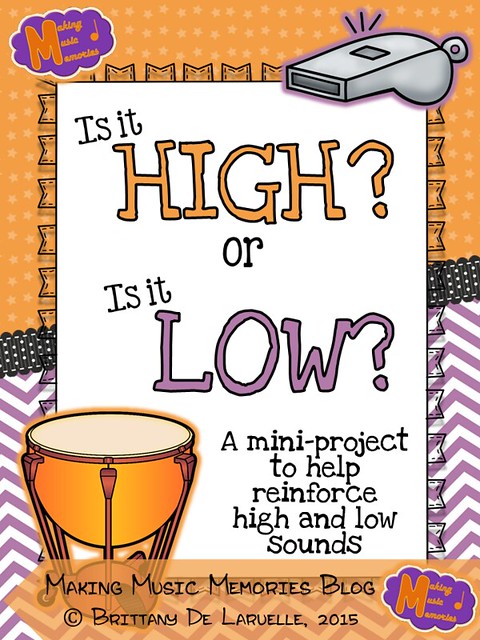
High and Low Worksheet Activity

High Low - Sorting Activity

This year I created a small project for us to work on to continue work on high vs. low. I really enjoyed this project because the students got excited about it. (It includes coloring, cutting, and gluing. All things Kindergarteners love.) Plus, it was an easy way for me to assess how students were doing with this concept. The first time I used this project with my first set of Kinders, I chose to do it too soon and students struggled with it. So, I tried it as one of my final activities with my second set of Kinders and they were rather successful with it.

Here is how it works:
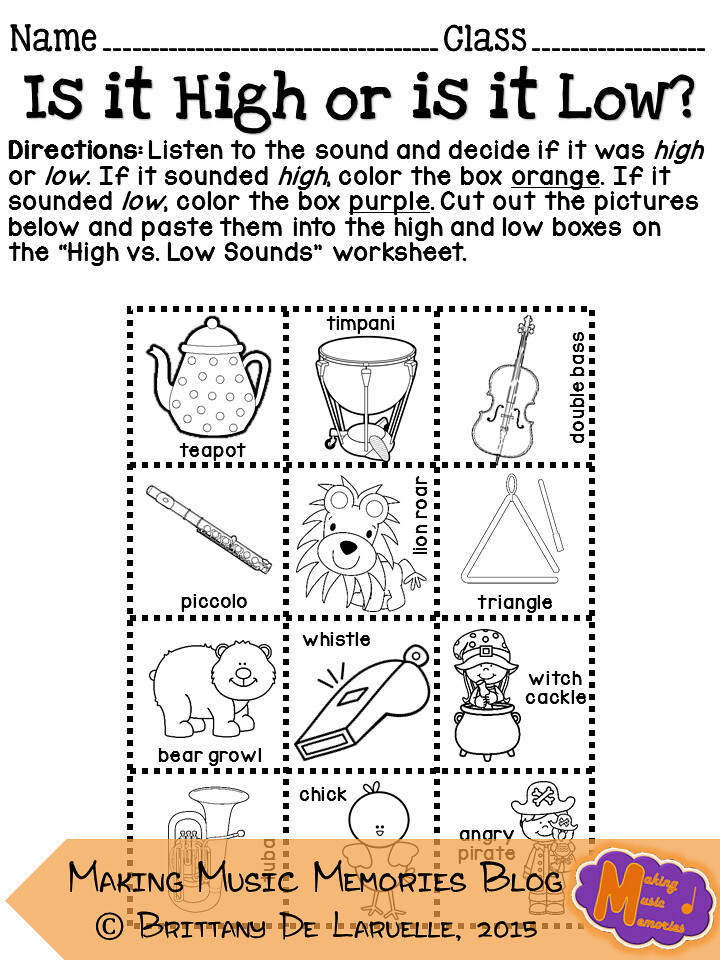
  1. First, students get the page with all the pictures of different items.
  2. High Low - Sorting Activity
  3. I played short music clips of each of these sounds for students to hear. I really stressed that they should NOT just pick based on what they thought, but on what they actually heard. (Link to these music clips is included in the file)
  4. As we went along, students colored the squares orange if they sounded HIGH and purple if they sounded LOW. Note: It's extremely important to continue to remind students they are listening for high and low. I also had students draw an orange - UP arrow and a purple - DOWN arrow to remind them what color they should color the square.
  5. After coloring all the pieces I had students turn them in. This gave me a chance to assess how they did and figure out which students I needed to work with on certain sounds.
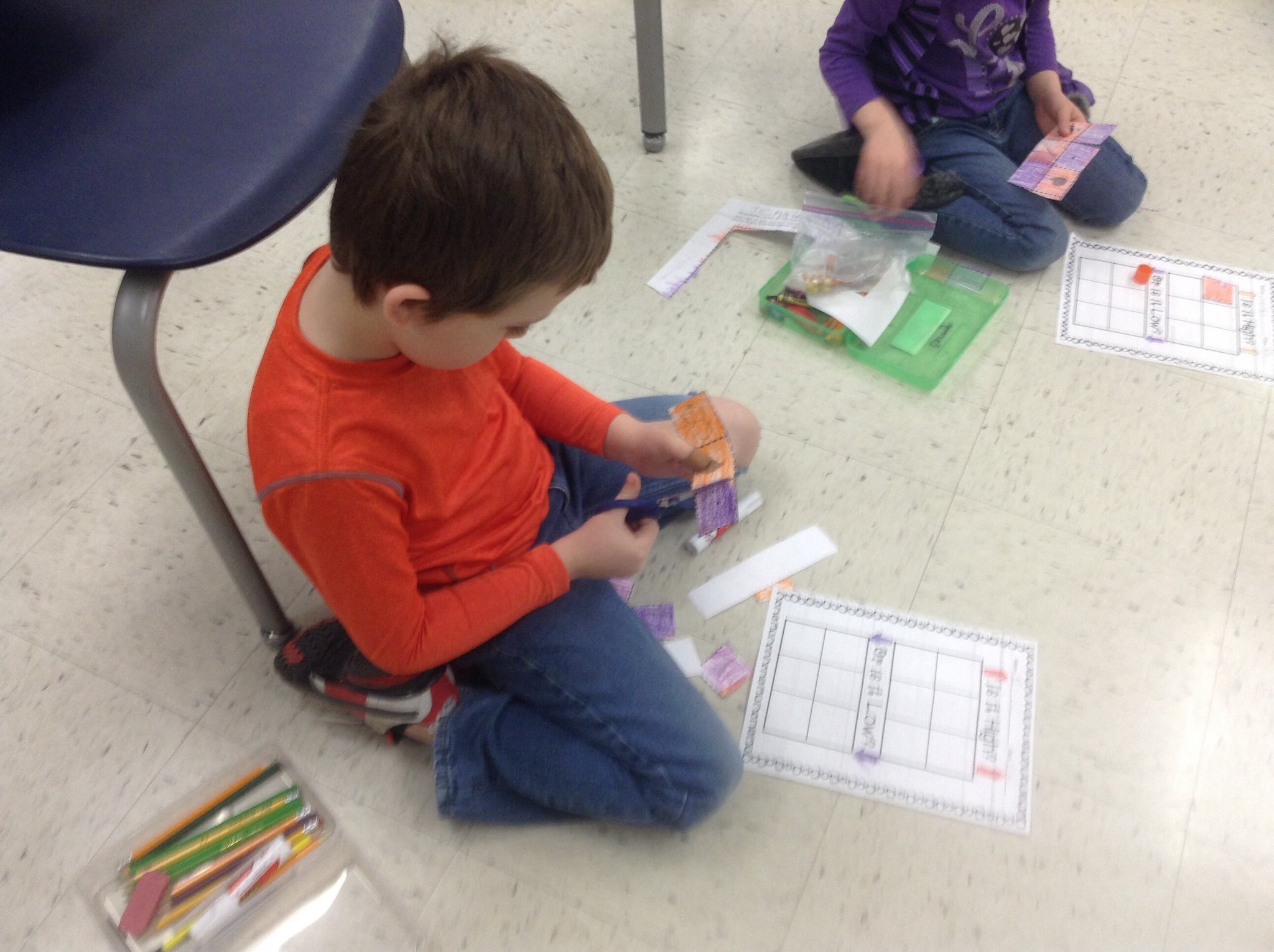
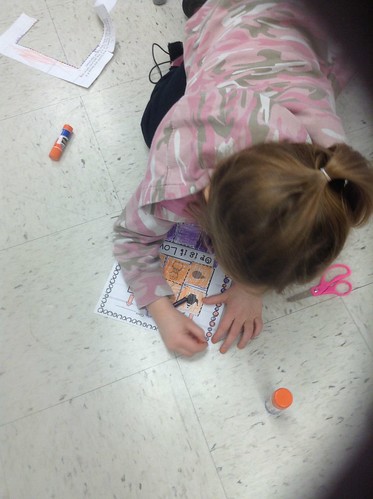
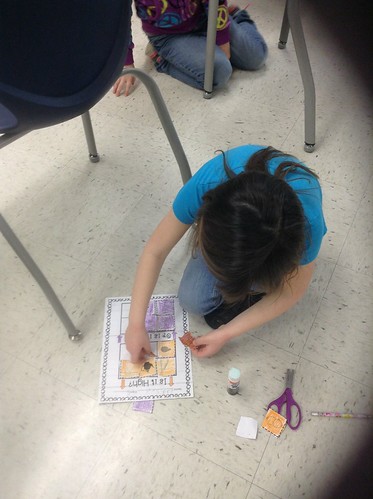
  6. The second day, I had students cut out their squares and glue them into the correct places on their "Is it High? Or is it Low?" worksheet. (With some classes, that did really well on this worksheet, I had them cut and glue on their own. Other classes, that struggled, went through the answers one by one and glued them in the correct places. This allowed them to easily see which ones they got right or wrong.)
    Working on high and low sortimageimage
In the end, some students ended up with sheets that looked 'perfect' and others were 'imperfect' but it was a great learning experience. I also found that after doing this activity my students were much more aware of high and low sounds. They didn't refer to everything as loud and soft all the time.

Now for the GREAT news! This project is a FREE download in my Teachers Pay Teachers store. You can download it HERE! Please feel free to download and use. I'd also really appreciate any and all feedback you can give me!

Monday, March 30, 2015

More High and Low

High and Low - Song and Game

Today, I'm going to talk about two high and low activities I have used in my classroom for several years now.

Five Little Monkeys
This is a great song I use for teaching high and low. Many of you probably already teach this song in your classrooms and you may even use it for teaching high and low. If not, here is how I incorporate it into the song.

We all sing "five little monkeys jumping on the bed" in our normal singing voices. When we get to the part where "Mama calls the doctor...", I have students switch into a high squeaky voice, to imitate Mama's high voice. Then on the "No more monkeys jumping on the bed!" students use their low voices.

When students get comfortable with the song, I'll start to pick students to be the mom and doctor voices alone. I'll pick one student to be the mom and one student to be the doctor. (After explaining that it doesn't matter if you are a boy or girl for either part.) This is a great chance for me to assess students actually getting into their high or low voices.

Five Little Monkeys - Cover

I just created a cute and simple file to go along with the song just for an added visual. It is free in my Teachers Pay Teachers store! You can download it by clicking on the Five Little Monkeys picture above, or just click HERE.

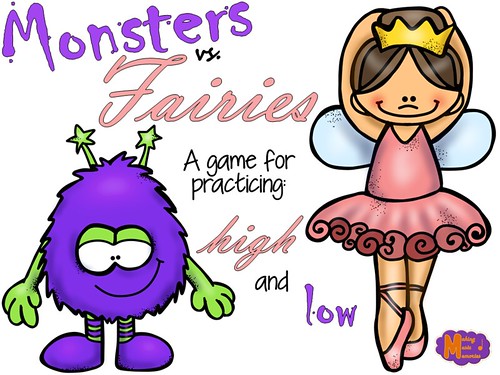
Monsters vs. Fairies
I also play a game using my piano that I have recently entitled Monsters vs. Fairies. The rules of the game are simple. When I play notes that are high on the piano, students reach up on their tippy toes with arms extended to the ceiling. When I play low notes on the piano, students should duck down toward the floor.

Monsters vs. Fairies

We call this game Monsters vs. Fairies because my students always say that the high notes sound like dancing fairies and the low notes sound like big furry monsters. (Oh the wonderful imagination of Kindergarteners.) This game is simple, but my students love it and will ask to play it. They especially like how I normally end the game by changing from high to low rather quickly. It gets them all giggly and happy before we move on to the next activity.

Looking for even MORE ideas for teaching high and low?
Check out my other blog entries about this topic:

Clip art credits: Kari Bolt, Educlips, MelonHeadz, Jena Hudson, Lovin' Lit
Font credits: Kimberly Geswein

Thursday, March 19, 2015

Beginning High and Low


High vs. Low Stories
A wonderful idea for continuing with high and low practice is telling your students some familiar folk tales. I started with telling my students the story of Goldilocks and the Three Bears. I tried to be as dramatic as possible while retelling this story and each of the three bears had a different kind of voice. Papa bear had a low voice, Mama bear had a middle voice, and Baby Bear had a high voice. (Goldilocks also had a high voice.)


At the end of the story, I asked how they knew different characters were speaking? They explained that I changed my voice. Then I asked them how I changed my voice. Some may think you were louder or softer with different voices. To show the difference I would use my Baby Bear and Papa Bear voices and speak quietly and then loudly. This helped them realize this was not the difference between my voices. After explaining, I changed my voice between high and low, I asked students who had the highest voice and who had the lowest voice.

Another day I told students the story of the The Three Little Pigs. After telling the story students were able to pick out the high and low voices quickly. We practiced speaking in our high pig voices and our low wolf voice.


The greatest part about using these stories is you already built a strong foundation you can come back to. When students are sure if something sounds high or low say "Does it sound like Baby Bear? Or does it sound like Papa Bear?" Some students may still struggle with it at the beginning, but with constant repetition and examples they will start to get it.

High vs. Low Videos
My students *LOVE* watching music videos and I have put together quite a list of music videos I show for different concepts. One day I was showing a video and I realized that it could be more high and low practice. I had students listen and tell me, which character is singing the lowest? Which is singing the highest? The students had a great time with identifying the high and low singers and I was amazed that my more advanced students could even pick out small differences in high and low. They even caught things in the videos that I didn't.

I started with showing students a video of Cookie Monster and a video of Elmo. I asked students which character has a high voice and which has a low voice.


Then I gave them a little more of a challenge, by figuring out who has the high and low voices in this video:

Then the ultimate challenge! I stopped after each number (starting on 2) and asked who had the highest/lowest voice. This is difficult for some, but this is also the one that my students really impressed me with.

Would you like to see more about teaching high and low?
Check out my last blog post about Preparing High and Low
Or look out for more posts about high and low COMING SOON

Clip art credits - Whimsy Clips & Educlips

Sunday, March 15, 2015

Preparing High & Low

I'd love to share some of my new (and old) activities for working on high and low with my students. This has been an extremely difficult concept for my Kindergarteners to understand, but this year I had every Kindergartener receive 100% on our assessment of opposites. (Which includes one question for loud/soft, one question for high/low, one question for fast/slow, and one question for long/short)

This year I got some fresh new ideas from many colleagues on the Facebook General Music Group. It is so great to collaborate with so many other music teachers and bounce off ideas. It was from this conversation that I received some ideas of new ways to teach this concept.

Vocal Explorations
Before I even talk about high and low, I work a lot with students on singing in their high and low voices. This includes having students match the pitch of a slide whistle I play for them. Saying phrases like 'mmm' going up and down with their voice. Plus, we do a lot of vocal explorations on the SMARTboard. The vocal explorations are my favorite to create and use in my classroom. If you aren't familiar with vocal explorations they are pictures with hills and lines showing the way students should sing. Students follow the image using their voice. They sing in their high voice when the line is toward the top of the picture and use their low voice when it is at the bottom. We normally have to practice a couple times before we really start to get good at it. One of the most common mistakes I get is when students just repeat the first image over and over again. I then remind them to look at the way the line is different and work on singing what it shows. Another common mistake is that students always want to end in their high voice. It helps when I point out before we start: Are we starting in our high or low voice? Are we ending in our high or low voice? Then I correct if students don't sing it correctly.

Here are some images of what vocal explorations look like:
ValentineVocalExploration1
ValentineVocalExploration2 Slide2 Slide6 SpringVE2

Note that some have lines and others are empty so your students can draw their own on your interactive white boards.

You can find a wide variety of these in my Teachers Pay Teachers Store:
Vocal Explorations
-OR-
You could create your own using Powerpoint.

If you aren't sure how to create your own Vocal Explorations and would like to learn more about how to do this please leave a comment on my facebook page or in the comments to let me know. I'd be happy to blog about how you can create your own (if there is enough interest).

Wednesday, October 8, 2014

Week 6 - How I Manage a Hectic Holiday Schedule

As I was sitting in church Sunday morning listening to the Psalm, I took a good look at the date. "October 5? That can't be right!" I thought... but it was and that means I have to introduce the Christmas concert audition process this week to the students at one of my schools. The other school is not having a Christmas concert. Instead they will have a 3-5 Winter Concert in January and a K-2 Spring Concert in April. They will then have a Christmas Sing-a-long towards the end of December, but that does not take NEARLY the amount of prep that a concert does. (As you all know)

Now after reading this you probably are wondering how I can keep everything straight. Sometimes I wonder the same exact thing, but here is kind of a glimpse into 'my world'.

My students at Bonduel Elementary always have two separate Christmas concerts, one in the morning and one in the afternoon each year. This year I decided that I am going to do a multi-cultural themed Christmas concert. I'm teaching some new songs, but also throwing in some common songs like Feliz Navidad and We Three Kings. I'm hoping this will appease my audience while still allowing me the opportunity to explore some newfound treasures. (I can tell you more about the songs we're singing and the programs I created in a couple weeks)

I have a very efficient audition process, which takes place during my music time. It includes instrument, speaking, and singing parts all in one day! I have 45 minute classes so I can fit it all in, but at the school with 30 minutes (more like 25 minutes) it normally takes two class periods. If you want to learn more about my audition process check out these two blog posts from last year:
Preparing Students for the Audition
What I Grade on for Try-outs

My students at Fairview Elementary will be continuing on with their lessons on beat, rhythm, solfege, etc. This can be ultra confusing! However, how I work it out I mostly focus on lesson planning for Fairview. Then everything I do with my students at Fairview during the concert prep months becomes my plans for Bonduel after concert season.

Week 6
Kindergarten
The next few weeks I will be assessing students five voices. I do this with a sort of a game. I take a familiar song we know like Chop, Chop or Frog in the Meadow and I call students up to the front of the room (or the back for those shier students). I whisper in their ear the voice I want them to use for the song and they demonstrate it for the class. This helps me figure out if they understand the correct vocabulary and also that they are able to use the correct voice. It is even better because students have to then determine what voice the student used.

Songs we are singing in Kindergarten this week:

1st Grade
After being introduced to beat and rhythm last week, students are continuing to practice seeing the difference between the two. I show students slides of songs they know with the beat and then show them with the rhythm. Students have to determine, which is which. Students this week are also starting to identify one sound beats and two sound beats (ta & ti-ti). We are focusing on the songs Bobby Shaftoe and Engine, Engine for this analysis.

Songs we are singing in 1st Grade this week:

2nd Grade
Students are working on composing short patterns using the notes we know: ta, ti-ti, rest, and ta-a. We are practicing how to draw these rhythms with the beat. We practiced yesterday by drawing patterns up on the SMARTboard. I also drew some rhythms incorrectly and students had to find the mistakes in the rhythms. They had a lot of fun with that. Especially because I really ham it up and make it seem like I'm just 'positive' I'm right. This practice will be very handy when it comes time to do their final composition project where they use half notes, half rests, whole notes, and whole rests. From past classes I know this is something I need to take more time on. Students get that certain notes are more than one beat, but they don't always show it the correct way in their compositions.

Songs we are singing in 2nd Grade this week:

3rd Grade
3rd Grade is now reviewing the whole note and will be doing a very similar practice to what the 2nd graders are doing this week. The only difference is we will add in the whole note. When students seem comfortable with composing with these notes I'll throw in the half rest and whole rest. We'll practice changing half notes into half rests and whole notes into whole rests. Then students will be ready to work on the composition they were supposed to complete in 2nd grade. I want to make sure they really understand this concept, since in 3rd grade their composition not only focuses on beats, but also throws in half beats! (Yikes!)

Songs we are singing in 3rd Grade this week:

4th Grade & 5th Grade
Students in 4th and 5th grade are learning about low so this week. They first learned about it using Scotland's Burning, but now are also practicing throwing it in to some other familiar songs. I'm surprised how much fun they are all having with the Chicken on the Fencepost game and the dance for Tideo. One of my 4th graders told their teacher "I don't know what activity I liked more!" How can that not bring a smile to your face?

Here are the activities for you to try:
Chicken on the Fencepost Game
  1. Make two circles - all students should be holding hands in their circles. They may complain about it at first, but when they see how the game works they get over it. (One inside circle and one outer circle)
  2. Pick two students to be the racers (They should close their eyes while you choose 'openings')
  3. Pick a set of hands on the outside circle and on the inside circle. These students will create an archway when the song ends, so the racers can get through to the middle (creating a kind of maze)
  4. Racers can open their eyes as the song starts and both circles walk to the beat of the song. When the song ends the students that are suppose to create arches do and the racers try to get to the middle as fast as possible.
  5. Repeat!
*Note: You can make it even harder by choosing some fake entrances. These students lift their arms creating an entry, but when someone gets close they quickly drop so no one can enter. Really fun and the kids think it is hilarious.

Here is a video of what this game looks like:


Tideo Dance
  1. Students partner up
  2. One partner creates an inside circle with their backs towards the middle of the circle
  3. Their partner lines up with them creating an outer circle with their faces towards the middle
  4. Pass one window - students on the outside move one person to their right
  5. Pass two windows - students on the outside move one person to their right
  6. Pass one window - Students on the outside move on person to their right
  7. Jingle at the window - All students pat their legs quickly
  8. Tideo - All students clap, clap, pat with the partner they are with
  9. Tideo, tideo - Students slowly swing their partner
  10. Jingle at the window - All students pat their legs quickly
  11. Tideo - All students clap, clap, pat with the partner they are with
  12. Tideo, tideo - Students slowly swing their partner
  13. Jingle at the window - All students pat their legs quickly
  14. Tideo - All students clap, clap, pat with the partner they are with
  15. Then repeat until you are lined up with the partner you started with (or whenever you want to stop)
*Note: I normally have my students repeat the dance by switching places with their partner. That way everyone gets a chance to try both parts.

Here is a video of this dance:

*Note: The version I learned of this song does the swinging partner two times, but you could do it just once like in the video

Songs we are singing in 4th Grade & 5th Grade this week:
  • Scotland's Burning
  • Canoe Song
  • Chicken on the Fencepost
  • Lil' Liza Jane
  • Tideo

Thursday, September 18, 2014

What's Happening Wednesday - Week 3

Here is a glimpse into my third week of school:
Kindergarten
Students are continuing to sing through the rules songs that I talked about in my post last week. We are also continuing to have experiences keeping the beat. This week I start allowing students to choose different beat motions. I always crack up at some of the choices students make for keeping the beat. We have the typical ones like clapping our hands, walking to the beat, or patting our head. But we also have some not so typical ones: shrugging our shoulders, blinking our eyes, or (a new favorite) swaying our hips back and forth.

Students this week will also continue to work on echoing short phrases. I use a lot of echo songs in the first couple months so that I can assess students ability to match pitch and echo short phrases. (One of our Kindergarten learning targets)

Songs we are singing in Kindergarten this week:
  • No More Pie
  • Chop, Chop, Chippity Chop
  • She'll Be Comin' Round the Mountain
  • My Aunt Came Back
  • Engine, Engine Number Nine
  • William He Had Seven Sons
  • Frog in the Meadow

1st Grade
The goals for 1st grade are being able to keep the beat to various different songs. Thsi will prepare them for recognizing notes that are longer and shorter, which then leads into ta and ti-ti. Normally by Halloween time students are able to recognize the difference between two sound and one sound words and clap rhythm patterns for ta and ti-ti.

Songs we are singing in 1st Grade this week:

2nd Grade
2nd graders are singing many songs with half notes and whole notes in them. In a few weeks we will learn about the half note and start working on creating patterns using quarter, eighth, and half notes. However, I'm introducing a lot of these whole note songs because we do learn about whole notes in 2nd grade, as well, and all of them use half notes, so we'll be able to practice our half notes even without learning about the whole note.

Songs we are singing in 2nd Grade this week:
  • Au Claire de la Lune
  • Frere Jacques
  • Here Comes a Bluebird
  • My Father's House
  • Who's That Tapping at my Window

3rd Grade
In 3rd grade we are reviewing all the notes we already know. We are singing various songs that use half notes and whole notes since we just learned about these at the end of the year. I also love that some of these songs the 3rd graders already knew because they sing them so beautifully!

Songs we are singing in 3rd Grade this week:
  • Au Claire de la Lune
  • All Through the Night
  • Frere Jacques
  • Here Comes a Bluebird
  • The Water is Wide
  • My Father's House
  • Who's that Tapping at my Window

4th Grade & 5th Grade
4th & 5th graders just learned the Alabama Gal dance last week. It was a LOT of fun and students are hoping to be able to get to it this week, too. Because of that this will be the reward students earn if they are following directions and working hard in music class.

My 4th and 5th graders are at two different places. I have some classes that have already learned all about ti ta ti and other classes that have not. This is definitely a challenge, so the goal is to get all the classes on the same page and really understanding how to clap rhythms using ti ta ti.

To work on practicing ti ta ti rhythms I have been working on using the rhythm games provided at the end of my Alabama Gal and Shake the Papaya Down rhythm files:


Yesterday, I picked one student to come up and play the rhythm on rhythm sticks. The goal for all the other students was to decide if they did it correctly or incorrectly. Students did a pretty good job of this and even picked up on minor incorrect patterns. (For example: adding a slight rest in between patterns, giving one note not enough time or too much time) I was really proud of how respectful they all were and how no one had to feel bad if they clapped a rhythm incorrectly.

Once all my classes are ready to move on from working on ti ta ti we will begin to take a look at low so and low la patterns. (We started to work on this last year)

Songs we are singing in 4th Grade & 5th Grade this week:

Wednesday, September 10, 2014

What's Happening Wednesday

I've decided to make a pact with myself and all of you that I will blog AT LEAST once a week. To make that happen, I'm devoting part of my Wednesday routine to writing a blog post.

This week is week 2 for me. (We normally start a little later here in Wisconsin.)

Here is a quick glimpse into my week:
Kindergarten
I'm still going through the music rules step by step in my classroom. I only see Kindergarten once a week at one of my schools and since I'm introducing one Rule Song a week, they won't be done with all the rules until October. It is a little sad to me that I don't get to see them all more often, but it is what it is! At my other school we are on to rule #3 and will be finishing rule #4 at the end of this week. (That is one stress of working in two different districts, it is sometimes very difficult to keep everyone on track or to remember where I am with different classes)

For my rules this year I'm using Lindsay Jervis's Rule Songs, as they came with her Owl Themed Rules. You can find them by clicking on the picture below:

Kindergarten is also beginning to work on keeping a steady beat and using their singing, whispering, and talking voices. I have not labeled any of these things yet, since it is only the second week of school, but we are starting to explore these concepts. For each song we sing students keep a beat in various ways and I often let students pick different ways of keeping the beat. We keep the beat slowly and quickly.

Songs we are singing in Kindergarten this week:

1st Grade
Now that we are in the second week of school we are reviewing some of the concepts we learned in Kindergarten to prepare for learning ta & ti-ti. I'm not yet labeling ta & ti-ti, but we are singing various songs that we will eventually learn ta & ti-ti with.

Songs we are singing in 1st Grade this week:

2nd Grade
In 2nd grade we are going to be reviewing ta & ti-ti and are currently preparing for ta-a. In order to do this I have picked out some songs that use ta, ti-ti, and ta-a. We will learn these songs and become comfortable singing them through a couple days of practice. When students are able to sing the songs on their own we will then begin to look at finding ta & ti-ti in the songs. Then later, we will work on figuring out our new note. My goal is to have introduced ta-a (and possibly ta-a-a-a) by November when we start working on our Christmas concert.

Since we are singing 2 French songs, I created a story to go along with introducing these songs by saying we were all going on a trip to France. Students had to find where France is on a map and we discussed how we would get there (plane, car, boat, etc.) This was a lot of fun. It is always great to incorporate a little bit of Social Studies into music class, as well as some global awareness.

Songs we are singing in 2nd Grade this week:

3rd Grade
Map
temp

As you can see my 3rd graders are doing similar things in music as my 2nd graders. We also looked at the map and found France. However, the reason I'm doing these songs in 3rd grade is to reinforce ta-a and ta-a-a-a. Some of my 3rd graders got to the assessment portion of half note, whole note, half rest, and whole rest, but another section didn't get to it. This will help review this concept for the classes that did assess it and prepare my other 3rd graders for assessing it.

Songs we are singing in 3rd Grade this week:

4th Grade & 5th Grade
My 4th & 5th graders ended the year after learning about ti ta ti and just beginning to look for low so and low la. I decided we would start with a couple ti ta ti songs that actually use low so and low la for added practice, since we weren't quite ready for the assessment at the end of 3rd grade. Shake the Papaya Down and Alabama Gal were two songs they learned last year that we are now reviewing ti ta ti with. When we seem comfortable with singing these songs and with the rhythm I'll start to work on the solfege for these concepts.

Along with singing my students began to learn the dance for Alabama Gal as a fun incentive for good behavior in music class. Both my 4th and 5th graders absolutely loved doing the dance yesterday, so it will be a great way to make sure we stay on task.

*NOTE: My 4th and 5th graders are around the same level because of when I started at these two schools. These classes aren't quite at the level where I would like them to be, but we are definitely getting closer every year.

Songs we are singing in 4th Grade & 5th Grade this week:

Wednesday, March 19, 2014

Tiptoe, Walk, and Jump

My kinders are starting to learn about long and short sounds. This is the last thing I need to teach for analysis this year. We have already learned about high vs. low, fast vs. slow, and loud vs. soft.

To learn about long and short I like to use the patterns tiptoe, walk, and jump. Tip-toe represents the two shortest sounds as it gets two sounds in the beat. Walk represents the one beat sound, and jump represents the longest sound (two beats). Jump, jumps from one beat to another. In order to practice this I normally have students jumping, tiptoeing and walking by their chairs for several days. Then I give them symbols to represent the three actions: two small dots for tip-toe, one short line for walk, and an upside down U for jump. I have students create their own patterns on the board with these symbols and we perform the actions together as a class.

This year I created a mini-composition for all the kids to work on, so EVERYONE gets a chance to create their own long and short patterns. There are only a few rules to their compositions. They have to create two lines of four beat patterns. (This means that the two dots of tip-toe must go together in a beat. You cannot separate them!) Jump has to take up two beats and you can only put a jump to beats 1 and 2, 2 and 3, or 3 and 4. (Otherwise you jump off the edge!) It is much easier to explain all of this visually to my kinders and they had no problem understanding what they needed to do.

Today, all my kinders created their own compositions and performed them for their classmates. Here are some pictures of finished compositions!

If you would like to use this composition in your own classroom, this is a forever freebie in my Teachers Pay Teachers Store and you can find it HERE. Please leave a rating and feedback if you use it, but please remember that it is free and nothing fancy by any means. Just something cute and simple! (Click the follow me link, if you haven't already, to be updated on all my future products and told about my special followers only deals.)

That's all for now!

Tuesday, October 8, 2013

2/4 Tuesday - More Music Books I Love


As I mentioned in previous posts (There Was an Old Woman Who Swallowed Some Leaves, Iza Trapani Books, & Get Ready to Romp) I love using books in my classroom.

Here are a few more I love:
  1. Freddie the Frog Series: I cannot believe I haven't talked about these already. They are remarkable. They tell the story of Freddie and his friend Eli the Elephant. There are 5 stories in all and they all help teach young children (ages 3-9) different music concepts. This includes tempo, treble clef notes, bass clef notes, and jazz. There is also a great site you can go to and reinforce the concepts used in the books. (Click on the picture to go to the Freddie the Frog Site)


  2. Puff the Magic Dragon: This book is the classic song, but has such beautiful illustrations! I love this song and I'm sure a lot of you do, too. My students love this song and ask for it all the time! (Click the picture for Amazon buying details)

On a completely new topic, I have continued to update the look of my blog! What do you think? I still have some things I want to continue to edit and I may still even change some of the pieces I updated, but I think it is really starting to look personalized. My goal is to make it look really nice as an inspiration to keep up with this blog. Make sure to check out the CONNECT TO ME links on the right to connect you with all the social media I'm apart of. (Including my new facebook page!) Also, if you have a music education blog button feel free to send it my way and I will add it.

Tuesday, October 23, 2012

Outdoor Instruments

As I talked about in my previous post, all my classes at Fairview went outside last week for music class. We had many different activities outside and the students learned a lot!

The Kindergarten and 1st graders were given a task of finding an object in nature that could be used as an instrument. After finding their make shift instruments the Kindergarten students got to share the instrument and play it for the class. I was impressed with the amount of creativity shown. A couple Kindergarteners used pinecones, leaves, sticks, rocks, or a combination of items.

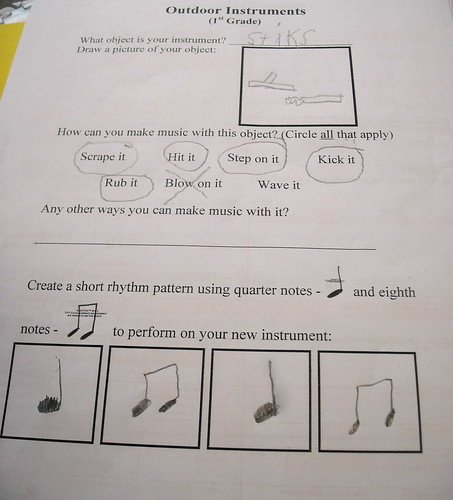
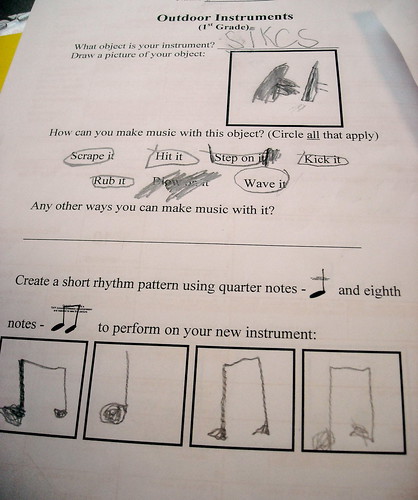
1st grade students filled out a short worksheet to go along with finding their object. This gave them a chance to continue practicing reading and writing skills, as well as, show me what they are learning.

The first part of the worksheet was telling me what their instrument was and drawing a picture of it. After that we figured out how the instrument could make music. I had several ways and each one students tried. As they tried them they would x out the ways that didn't work and circle the ways that did work. (We went one by one as a class so the ones that had more difficulty reading always knew the task.) My 1st graders loved trying to find out the ways their instrument made music. They enjoyed hitting, shaking, scratching, etc. their instrument to try to make noise. I really enjoyed watching them try all the different ways and was SO happy to see them only using their instruments as instruments and not as weapons. (We did talk about that before hand JUST in case.)

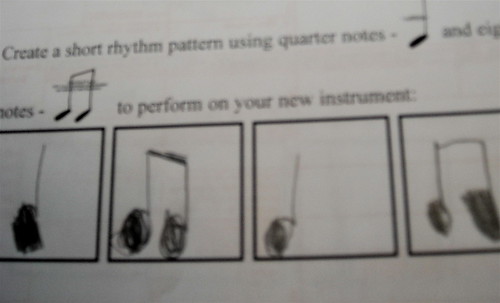
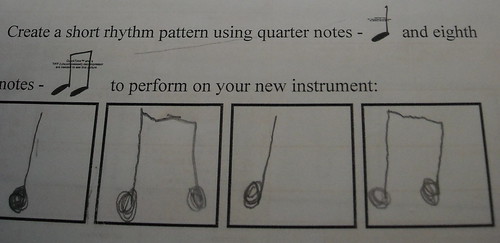
At the bottom of the worksheet 1st graders had to come up with a rhythm using quarter notes and eighth notes. I created four boxes and explained that they had to choose either a quarter note or a pair of eighth notes for each box. They could not put BOTH in any of the boxes. All the kids followed the directions! YAY! Finally, each 1st grader got to play their instrument for the class sharing both their rhythm and instrument. It was so much fun!

Here are some of the finished worksheets:
Worksheet Example #4
Worksheet Example #3
Worksheet Example #2
Worksheet Example #1

Interested in seeing the worksheet I created. Find it -->here!<---

To finish the day, I always like to share a songtale or story with my Kindergarten - 2nd grade classes. This is part of the routine of my classes and students have come to expect it and know that story time means the end of music class. To go with the theme of being outside in nature I sang the story There Was an Old Lady Who Swallowed Some Leaves.

The kids chuckled at the silliness of an old lady swallowing a pumpkin. They also liked guessing what the old lady sneezes out after swallowing all the things she does. What a great way to end the lesson!

Make some musical memories today!

Tuesday, October 16, 2012

Outdoor Music Class!

Sound Effects
Last week I decided to take all of my Fairview students outside for music classes. I decided to do this after having a short chat with a 2nd grader who often acts up in my class. He had kind of a rough day about two weeks ago and broke down in tears after music class. I asked him if he was crying because he got in trouble, to which he replied "No! I just really miss my mom!"

Fairview has an outdoor classroom that they refer to as The School Forest. At first, I wasn't sure what we should do outside. It would be easy to just go out there and sing different songs we sing in music class. However, I feel that when you are going to a new environment you should take advantage of it to the best of your abilities.

After much thought I came up with lesson plans for each class. I will introduce the ideas here with a brief description, but I'll also post more details on each project in later blog posts. This way you can get the materials I used for the lessons, as well as, see some pictures. (I don't want to bombard you with a whole week of lessons in one post!)

All my classes had to walk on the forest path in silence. While they did this they were to listen to the sounds of fall. When we reached the outdoor classroom, I then had students share what they heard. We talked about what music was and how the music of fall would be different than the music of winter. They imagined some of the sounds they may hear in the winter rather than the fall. I especially found this activity cute when one of my kindergarteners on the second day of going to the forest told the class that he heard some beautiful music on his walk to the school forest. This was without even being told to listen for music! :)

Sound Effects

In Kindergarten and 1st grade students had to find an item in nature that could be used to create music. They then shared these instruments with the class and showed them how to play their instrument. (Read more about outdoor instruments...)

2nd grade was working on a sound effects project out in the school forest. (Read more about sound effect project...)

3rd grade was finishing up their ostinato patterns, so the first day they shared their patterns with the class. The second day they did something similar to what the 4th and 5th graders did. (Read More about the Ostinato Pattern Project...)

4th and 5th graders went out the school forest and sang I Love the Mountains. Afterwards they were asked to write a short reflection on this experience. They were to describe the difference in singing outside versus inside. We then talked about what makes a good reflection and ways to describe the sound of our own singing or of instruments playing, etc. 4th and 5th graders then created their own 2 beat ostinatos with a partner, as well as, a 3 beat ostinato with their partner. Students created and practiced them the first day and then shared them the second day. (Read More about reflections...)

Overall, I really enjoyed taking the kids out for music class. I was surprised by how many of my students, that don't always care for music, were really excited about music since we were going outside. I also noticed that some of my overly rambunctious students were actually really well behaved outside.

Have a musical day!